Content updated September 2026
Barbell Back Squat
Save
Primary
Quadriceps
Secondary
Glutes, Hamstrings, Core
Equipment
Barbell
Difficulty
Intermediate
Type
Squat
See how Barbell Back Squat could fit a workout
The example below shows one possible placement. Your purchased plan is built from your assessment, and Ely checks every exercise before approving it.
One-time purchase · Checked by Ely · Delivered in 1–3 business days
This page is not medical advice or a rehabilitation protocol. Ely's personal review applies to purchased workout plans and does not replace an in-person assessment by a licensed healthcare professional.
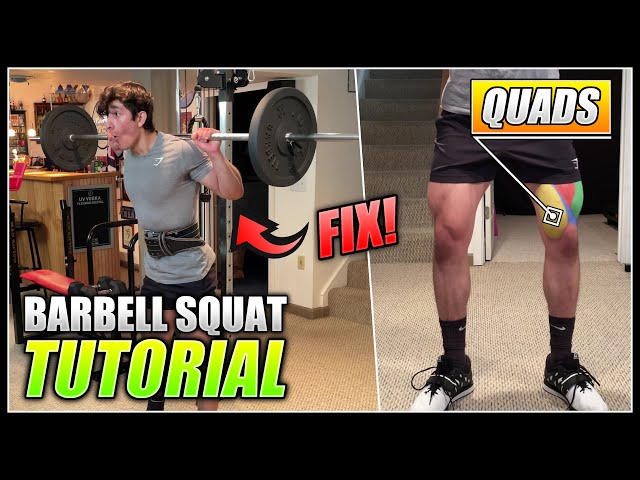
The barbell back squat is the foundational lower body strength movement, loading your entire posterior chain while demanding quad strength through a full range of motion. Unlike machine alternatives, back squats develop total-body coordination and core stability alongside raw leg power. This is the exercise that built more strong legs than any other in strength sports history.
Coaching Note
Your squat depth matters more than your squat weight. Hit parallel or below on every rep before chasing numbers. The lifters who build the strongest legs treat depth as non-negotiable and only add weight when form is automatic.
What muscles does the Barbell Back Squat work?
Secondary
Stabilizers
Why This Exercise Works
The barbell back squat is the most demanding compound lower body exercise because it loads your entire kinetic chain from your feet to your upper back. Your quadriceps (the four muscles on the front of your thigh) are the primary movers, driving knee extension as you stand up from the bottom position. The deeper you squat, the more quad muscle fiber you recruit — this is why exercise science research emphasizes full depth squats for quad hypertrophy (muscle growth).
Your glutes fire hardest in the bottom half of the squat where your hips are maximally flexed. Going below parallel increases gluteus maximus activation by 25-35% compared to quarter squats, as EMG research demonstrates. This is the main reason half-squats build less muscle — you're skipping the range where glutes work hardest.
Your hamstrings play a supporting role as hip extensors, but they're not the primary target. They co-contract with your quads to stabilize your knee joint throughout the movement. Your adductors (inner thigh muscles) assist significantly, especially in wider stances. A shoulder-width stance emphasizes quads; a wider stance shifts more work to adductors and glutes.
The back squat demands enormous core stability. Your erector spinae (the muscles running alongside your spine) work isometrically to keep your torso upright under heavy load. Your rectus abdominis and obliques brace against the barbell's compressive force. Research has demonstrated that heavy squats produce core activation comparable to direct ab work — one reason many strong squatters have thick midsections without dedicated core training.
Bar position changes muscle emphasis. High bar (bar on upper traps) keeps your torso more upright and targets quads more directly. Low bar (bar on rear delts) allows more hip hinge, shifting emphasis toward glutes and posterior chain. High bar is recommended for bodybuilders focused on quad development and low bar for powerlifters maximizing total weight, as strength researcher Greg Nuckols has documented.
Your calves act as stabilizers at the ankle, and your upper back muscles (traps, rhomboids) work hard to maintain bar position. This is why a weak upper back limits squat performance even though it's not a "leg" weakness.
Browse all quadriceps exercises
Also targets: Glutes, Hamstrings, Core
Want Ely to consider Barbell Back Squat for your plan?
Share your training details. Ely reviews the full week before anything is delivered.
Step-by-step: Barbell Back Squat
- 1
Set up the barbell in a squat rack at chest height.
- 2
Step under the bar and position it on your upper back.
- 3
Grip the bar wider than shoulder-width and unrack it.
- 4
Take two steps back with feet shoulder-width apart.
- 5
Brace your core and squat down by bending your knees.
- 6
Descend until thighs are at least parallel to the floor.
- 7
Drive through your feet to stand back up.
What are the best tips for the Barbell Back Squat?
Keep your chest up and back tight throughout.
Push your knees out in line with your toes.
Drive through your whole foot, not just heels or toes.
Take a big breath and brace before each rep.
When to Use the Barbell Back Squat
Program barbell back squats as your primary lower body movement at the start of leg day when you are freshest. Pair with Romanian deadlifts for complete quad-hamstring development, or follow with leg press for additional quad volume when your stabilizers fatigue. Choose back squats over front squats when you want to move heavier loads and train your posterior chain alongside quads.
What are common Barbell Back Squat mistakes to avoid?
Knees caving inward during the lift.
Rising hips faster than shoulders (good morning squat).
Not hitting sufficient depth.
Losing core tightness at the bottom.
Who should do the Barbell Back Squat?
Intermediate to advanced lifters. Master goblet squat first.
Programming examples for Barbell Back Squat
The sets, reps, and rest times below are examples. Adjust them for your current ability, the exercise, and your total training. These ranges are not exclusive to one goal.
Example: 3-5 sets of 5-8 reps for strength. Rest 3-5min between sets.
Muscle Growth
6-12 reps
Example rest: 90s-2min; extend as needed
Strength
1-5 reps
Example rest: 2-3min; extend as needed
Endurance
12-20 reps
Example rest: 60s; extend as needed
Where to Use in Your Workout
Always first exercise on leg day. Your nervous system and spinal erectors need to be completely fresh. Follow with a hip-hinge movement (Romanian deadlift or leg curl) for balanced development, then isolation work like leg extensions.
Sample Workout Blocks
Strength: 5x5 @ RPE 8 (3-5 min rest) | Hypertrophy: 4x8-10 @ RPE 7-8 (2-3 min rest) | Volume: 3x12-15 @ RPE 7 (90s rest) | Deload every 4th week at 60%
Want help choosing exercises, sets, and reps for your schedule? Ely reviews purchased plans before delivery.
Get Your Custom PlanWhere Barbell Back Squat fits in your workout
This is one example of how Barbell Back Squat could sit inside a complete workout. Your plan may use different movements after Ely checks your assessment.
Sample workout
- Squat or Leg Press4 × 8
- Romanian Deadlift3 × 10
- Barbell Back Squat3 × 12
- Calf Raise3 × 15
Use this exercise in Gym Mode
MySetPlan guides you set by set, times your rest, records your work, and tells you what to do next from the plan Ely approved.
Start My $19 WeekWhat are good alternatives to the Barbell Back Squat?
Front Squat
QuadricepsBarbellIntermediate
Goblet Squat
QuadricepsDumbbellBeginner
Leg Press
QuadricepsMachineBeginner
Other Variations
- High Bar Squat
- Low Bar Squat
- Pause Squat
- Box Squat
Variation Details
Goblet Squat
Hold a dumbbell at chest level. Great for learning squat mechanics and for high-rep work. Use as a warm-up or when barbell squats aren't available.
Leg Press
Machine alternative that removes spinal loading. Use after back squats for additional quad volume when your back is fatigued, or as a primary movement if you can't barbell squat.
Pause Squat
Hold the bottom position for 2-3 seconds. Builds strength out of the hole and improves stability. Use as a variation every 4-6 weeks.
Box Squat
Squat to a box or bench behind you. Teaches consistent depth and develops hip power. Good for lifters who struggle with depth control.
Barbell Back Squat vs Other Exercises
vs Front Squat
Back squats let you go 20-30% heavier and work more total muscle. Front squats isolate quads better and are easier on the lower back. Use back squats as your primary leg builder; add front squats when you want extra quad work without more spinal loading.
vs Leg Press
Leg press removes spinal loading entirely, letting you push quad volume without lower back fatigue. Back squats build more total-body strength, coordination, and core stability. Use squats as your primary movement, leg press as your volume builder afterward.
vs Goblet Squat
Goblet squats are the best squat variation for beginners — the front load teaches upright posture naturally. Back squats allow far more loading for intermediate and advanced lifters. Graduate from goblet to barbell once you can do 20+ reps with a heavy dumbbell.
Want a plan you do not have to piece together?
Share your goal, schedule, equipment, and experience. Ely checks the complete exercise selection before he approves your week.
Start My $19 Starter Week$19 once · No automatic renewal · Delivered in 1–3 business days
Related Content
Safety Notes
- Always use a squat rack with safety bars.
- Learn proper bracing technique.
- Start with lighter weights to master form.
- Have a spotter for heavy sets.
- General fitness education only. This is not medical advice or a rehabilitation protocol. Stop if you feel pain, and follow a licensed healthcare professional for an injury, medical condition, or return after surgery.
Related Workout Plan Guides
Compare This Exercise
Barbell Back Squat vs Leg Press
Barbell squats build more total-body strength and functional fitness, while leg press allows heavier quad loading with less technical demand. Choose based on your goals and mobility.
Barbell Back Squat vs Deadlift
Both squats and deadlifts are essential for complete strength development. Squats prioritize quads while deadlifts emphasize the posterior chain. Include both for optimal results.
Barbell Back Squat vs Front Squat
Front squats emphasize quads and core with a more upright torso, while back squats allow heavier loads and target glutes more. Both are excellent leg builders.
Barbell Back Squat vs Goblet Squat
Barbell squats build maximal leg strength, while goblet squats are excellent for beginners and mobility work. Progress from goblet to barbell squats.