General exercise guide
Goblet Squat
Save
Primary
Quadriceps
Secondary
Glutes, Core
Equipment
Dumbbell
Difficulty
Beginner
Type
Squat
See how Goblet Squat could fit a workout
The example below shows one possible placement. Your purchased plan is built from your assessment, and Ely checks every exercise before approving it.
One-time purchase · Checked by Ely · Delivered in 1–3 business days
This page is not medical advice or a rehabilitation protocol. Ely's personal review applies to purchased workout plans and does not replace an in-person assessment by a licensed healthcare professional.
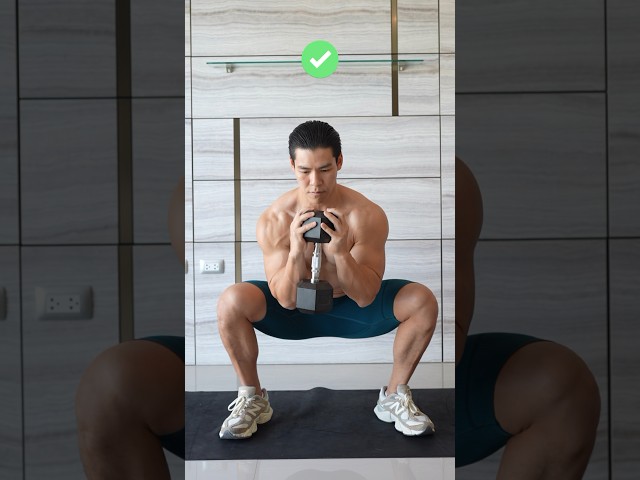
The goblet squat holds a dumbbell or kettlebell at your chest, creating a front-loaded squat that naturally teaches upright torso positioning and deep squatting mechanics. The weight acts as a counterbalance that helps you sit back while keeping your chest up—exactly what makes squats difficult for beginners. This is the best first loaded squat variation for anyone learning to squat.
Coaching Note
Let the weight pull you into position. The goblet squat teaches itself: if you lean forward, the weight punishes you; if you stay upright, it helps you balance. Lower until your elbows touch your inner thighs for a depth cue.
Muscles worked: Goblet Squat
Why This Exercise Works
The goblet squat is a quad-dominant squat variation that also produces significant glute activation. Holding the weight at chest level shifts your center of gravity forward, which naturally keeps you more upright and allows deeper squatting without the forward lean required by back squats. This upright torso position increases knee flexion demands, emphasizing the quadriceps — particularly the rectus femoris and vastus muscles. The glutes work powerfully during hip extension as you drive out of the bottom position. Unlike barbell back squats where spinal erector fatigue often limits the lift, the goblet position places minimal stress on the lower back while creating significant anti-flexion demand on the core to hold the torso upright. The front-loaded position also naturally teaches proper squat mechanics: sitting back into the hips while keeping the chest tall, making it an excellent teaching tool for beginners before progressing to barbell variations.
EMG analysis shows that quad activation increases progressively as you descend deeper into the goblet squat, peaking when the thighs reach parallel or below. This is why depth matters for quad development — half squats miss the most productive portion of the range of motion. The glutes activate most powerfully during the drive out of the bottom position. The anterior core muscles (rectus abdominis, obliques) work constantly to prevent the weight from pulling you forward, which is why goblet squats can be surprisingly taxing on the abs when heavy weights are used. The upper back muscles (rhomboids, rear delts) also work isometrically to hold the chest tall. Adding a 2-second pause at the bottom eliminates the stretch reflex and significantly increases the difficulty, forcing the quads to generate force from a dead stop rather than bouncing out of the hole.
Want Ely to consider Goblet Squat for your plan?
Share your training details. Ely reviews the full week before anything is delivered.
Goblet Squat form guide
- 1
Hold a dumbbell or kettlebell at chest height.
- 2
Cup the weight with both hands close to your body.
- 3
Stand with feet slightly wider than hip width.
- 4
Squat down while keeping the weight at your chest.
- 5
Lower until your elbows touch your knees.
- 6
Drive through your feet to stand back up.
What are the best tips for the Goblet Squat?
Keep your chest up and elbows high.
The weight acts as a counterbalance.
Go as deep as mobility allows.
Great for learning squat mechanics.
When to Use the Goblet Squat
Program goblet squats as a warm-up before heavy barbell squats, as a primary squat for beginners, or as a high-rep finisher for advanced lifters. Use them in home gym settings or when traveling. They pair well with any hip hinge movement for complete lower body training.
What are common Goblet Squat mistakes to avoid?
Letting the weight pull you forward.
Not going deep enough.
Elbows flaring out wide.
Rising hips faster than shoulders.
Is the Goblet Squat right for you?
Beginners learning squat mechanics before progressing to barbell variations. Lifters with mobility limitations who struggle to hit depth on back squats. Home gym athletes using goblet squats as their primary quad builder.
Programming examples for Goblet Squat
The sets, reps, and rest times below are examples. Adjust them for your current ability, the exercise, and your total training. These ranges are not exclusive to one goal.
Example: 3-4 sets of 10-12 reps. Rest 60-90s.
Muscle Growth
10-15 reps
Example rest: 90s-2min; extend as needed
Strength
6-8 reps
Example rest: 2-3min; extend as needed
Endurance
15-20 reps
Example rest: 60s; extend as needed
Where to Use in Your Workout
Use as warm-up before heavy barbell squats (2-3 light sets) or as primary squat variation for beginners and home gym lifters. The self-limiting load makes it ideal for high-rep finishers after heavier compound work.
Sample Workout Blocks
Week 1: 3x12 @ RPE 7 | Week 2: 3x12 @ RPE 8 | Week 3: 4x10 @ RPE 8 | Week 4 (deload): 2x15 @ RPE 6
Want help choosing exercises, sets, and reps for your schedule? Ely reviews purchased plans before delivery.
Get Your Custom PlanWhere Goblet Squat fits in your workout
This is one example of how Goblet Squat could sit inside a complete workout. Your plan may use different movements after Ely checks your assessment.
Sample workout
- Squat or Leg Press4 × 8
- Romanian Deadlift3 × 10
- Goblet Squat3 × 12
- Calf Raise3 × 15
Use this exercise in Gym Mode
MySetPlan guides you set by set, times your rest, records your work, and tells you what to do next from the plan Ely approved.
Start My $19 WeekWhat are good alternatives to the Goblet Squat?
Other Variations
- Pause Goblet Squat
- Tempo Goblet Squat
- Goblet Squat to Press
Variation Details
Pause Goblet Squat
Hold the bottom position for 2-3 seconds before driving up. This eliminates the stretch reflex, builds strength out of the hole, and ensures you are not using momentum. Pause squats are excellent for building bottom position strength and improving depth confidence.
Tempo Goblet Squat
Use a controlled tempo such as 3 seconds down, 1 second pause, 2 seconds up. Tempo training increases time under tension for greater hypertrophy stimulus and improves movement control. Reduce weight significantly when first adding tempo work.
Goblet Squat to Press
Perform a goblet squat, then press the weight overhead as you stand. This combines lower and upper body work for a full-body movement that increases training density. Great for conditioning workouts or when time is limited.
Sumo Goblet Squat
Take a wider stance with toes pointed out more than usual. This shifts emphasis toward the adductors and glutes while reducing quad demand. Some people find the sumo stance more comfortable if hip mobility is limited.
Heels Elevated Goblet Squat
Place your heels on small weight plates or a wedge. This reduces ankle mobility demands and shifts emphasis even more toward the quadriceps. Useful for those with limited ankle dorsiflexion or for targeting quad development specifically.
Goblet Squat vs Other Exercises
Dumbbell squats with weights at your sides allow heavier total loading but require more core strength to maintain an upright torso. Goblet squats keep you more upright naturally due to the front-loaded position, making them better for beginners or those with mobility limitations. Use goblet squats for learning mechanics and achieving depth; use dumbbell squats when you need more resistance than one weight at chest level provides.
Bodyweight squats are useful for warming up and very high-rep conditioning work, but the lack of resistance limits strength and muscle-building potential. Goblet squats add progressive resistance while maintaining similar mechanics. Use bodyweight squats for warm-ups and conditioning; use goblet squats when your goal is building strength and muscle with a beginner-friendly movement pattern.
Want a plan you do not have to piece together?
Share your goal, schedule, equipment, and experience. Ely checks the complete exercise selection before he approves your week.
Start My $19 Starter Week$19 once · No automatic renewal · Delivered in 1–3 business days
Related Content
Safety Notes
- Keep the weight close to your body.
- Start with lighter weight.
- Focus on depth over load.