General exercise guide
Tricep Pushdown
Save
Primary
Triceps
Secondary
Shoulders, Core
Equipment
Cable
Difficulty
Beginner
Type
Push
See how Tricep Pushdown could fit a workout
The example below shows one possible placement. Your purchased plan is built from your assessment, and Ely checks every exercise before approving it.
One-time purchase · Checked by Ely · Delivered in 1–3 business days
This page is not medical advice or a rehabilitation protocol. Ely's personal review applies to purchased workout plans and does not replace an in-person assessment by a licensed healthcare professional.
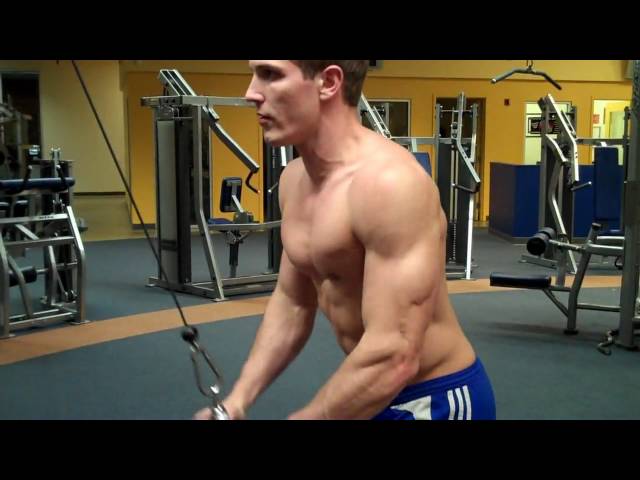
Tricep pushdowns are the foundational cable isolation exercise for building tricep size. The constant cable tension and simple movement pattern make this exercise accessible to all levels while still effective for advanced lifters. Pushdowns primarily target the lateral head of the triceps, creating the horseshoe shape when viewed from behind.
Coaching Note
Lock your elbows at your sides as if they are welded in place—they should not move forward or backward. The only movement is elbow extension. If you find your shoulders engaging or elbows drifting, reduce the weight immediately.
Tricep Pushdown — targeted muscles
Why This Exercise Works
The tricep pushdown isolates the triceps brachii—a three-headed muscle that makes up roughly two-thirds of your upper arm mass. The lateral head, medial head, and long head all contribute to elbow extension, but the pushdown emphasizes the lateral and medial heads due to your arm position.
The lateral head is the outermost portion of the triceps and creates the horseshoe shape when well-developed. The lateral head activates most strongly during pushdowns with a pronated grip (palms facing down) using a straight bar—a finding confirmed by Dr. Brad Schoenfeld's EMG research on triceps activation patterns. The lateral head is the most visible tricep head from the front and side, making pushdowns a priority for aesthetic arm development.
The medial head sits deep underneath the other two heads and acts as the workhorse of elbow extension. It activates in every tricep movement regardless of arm position. The medial head is particularly active during the lockout portion of pushdowns—the last 30 degrees of extension. Emphasize the lockout squeeze to maximize medial head recruitment.
The long head is the largest tricep head and crosses both the elbow and shoulder joints. Because the long head attaches to the scapula, it shortens at the shoulder when your arm is at your side during pushdowns. This means pushdowns place the long head in a mechanically disadvantaged position—shortened at both ends. For complete tricep development, pair pushdowns with overhead extensions that stretch the long head.
Cable tension provides a unique stimulus compared to free weights. The pulley system maintains constant resistance throughout the entire range of motion. Constant tension exercises may produce greater metabolic stress—one of the three primary mechanisms of hypertrophy alongside mechanical tension and muscle damage, as Dr. Brad Schoenfeld's hypertrophy research has demonstrated.
Grip and attachment choice affects which head gets emphasized. A straight bar with overhand grip targets the lateral head most. A V-bar allows a neutral grip that distributes load more evenly. A rope attachment allows wrist rotation at the bottom—spreading the rope apart at lockout increases lateral head activation. Attachment variation across training cycles is a simple way to ensure balanced tricep development, a principle emphasized by strength researcher Greg Nuckols.
Want Ely to consider Tricep Pushdown for your plan?
Share your training details. Ely reviews the full week before anything is delivered.
How do you perform the Tricep Pushdown?
- 1
Stand facing high cable pulley with bar or rope attached.
- 2
Grip attachment with overhand grip, elbows at sides.
- 3
Push attachment down by extending elbows.
- 4
Squeeze triceps at full extension.
- 5
Control the weight back up to 90 degrees.
- 6
Repeat without letting elbows drift forward.
What are the best tips for the Tricep Pushdown?
Keep elbows pinned at sides throughout.
Focus on the squeeze at bottom.
Dont let shoulders take over.
When to Use the Tricep Pushdown
Program pushdowns after compound pressing movements like bench press or overhead press. They work well as a primary tricep isolation exercise or as a finishing movement. The constant cable tension makes them ideal for higher rep ranges (12-15+) and metabolic stress.
What are common Tricep Pushdown mistakes to avoid?
Letting elbows drift forward - uses shoulders.
Using body momentum - reduces isolation.
Partial reps - limits development.
Tricep Pushdown — who it's best for
All levels. Staple tricep exercise for size and strength.
Programming examples for Tricep Pushdown
The sets, reps, and rest times below are examples. Adjust them for your current ability, the exercise, and your total training. These ranges are not exclusive to one goal.
Example: 3-4 sets of 12-15 reps. Rest 45-60 seconds.
Muscle Growth
10-15 reps
Example rest: 90s-2min; extend as needed
Strength
6-8 reps
Example rest: 2-3min; extend as needed
Endurance
15-25 reps
Example rest: 60s; extend as needed
Where to Use in Your Workout
Program pushdowns after compound pressing movements like bench press or overhead press. They work as a primary tricep isolation exercise or finishing movement. 6-12 direct tricep sets per week across all exercises (compounds count as partial volume). Rep range: 10-15 for most sets, 15-25 for pump work. Rest 60-90 seconds. Tempo: 1s concentric with lockout squeeze, 2s eccentric. Increase by one plate (5-10 lbs) when you hit top of rep range for all sets.
Sample Workout Blocks
Push Day Tricep Block:
1. Close-Grip Bench Press — 3x8-10 (2 min rest)
2. Tricep Pushdown (straight bar) — 3x12-15 (60s rest)
3. Overhead Cable Extension — 2x15-20 (60s rest)
Total direct tricep volume: 8 sets (plus indirect from pressing)
Want help choosing exercises, sets, and reps for your schedule? Ely reviews purchased plans before delivery.
Get Your Custom PlanWhere Tricep Pushdown fits in your workout
This is one example of how Tricep Pushdown could sit inside a complete workout. Your plan may use different movements after Ely checks your assessment.
Sample workout
- Bench Press4 × 8
- Incline Dumbbell Press3 × 10
- Tricep Pushdown3 × 12
- Overhead Triceps Extension3 × 15
Use this exercise in Gym Mode
MySetPlan guides you set by set, times your rest, records your work, and tells you what to do next from the plan Ely approved.
Start My $19 WeekWhat are good alternatives to the Tricep Pushdown?
Rope Pushdown
TricepsCableBeginner
Overhead Tricep Extension
TricepsDumbbellBeginner
Skull Crusher
TricepsEZ BarIntermediate
Overhead Cable Extension
TricepsCableBeginner
Other Variations
Variation Details
Rope Pushdown
Uses a rope attachment allowing you to spread the ends apart at the bottom of the movement. This rotation increases lateral head activation at peak contraction. Allows slightly more natural wrist positioning than a straight bar.
Single-Arm Pushdown
Perform pushdowns one arm at a time using a single handle attachment. Eliminates bilateral compensation and allows you to identify and correct strength imbalances between arms. Also increases core anti-rotation demand.
Tricep Pushdown vs Other Exercises
Overhead extensions stretch the long head of the triceps—the largest head—because your arms are overhead. Pushdowns keep the long head shortened. For complete tricep development, you need both: pushdowns for lateral and medial heads, overhead work for the long head.
Skull crushers are a free-weight tricep isolation exercise that provides a stretch on the long head (arms angled overhead). They allow heavier loading than pushdowns but carry more elbow stress risk. Pushdowns are safer for high-volume work; skull crushers are better for progressive overload.
Pushdowns dominate the lateral head of the triceps because your arm stays at your side. The overhead cable extension puts the long head — the largest of the three tricep heads — in a stretched position under load. Running both in the same week is how you build tricep size that shows from every angle.
Want a plan you do not have to piece together?
Share your goal, schedule, equipment, and experience. Ely checks the complete exercise selection before he approves your week.
Start My $19 Starter Week$19 once · No automatic renewal · Delivered in 1–3 business days
Related Content
Safety Notes
- Keep elbows stationary.
- Dont use excessive weight.
- General fitness education only. This is not medical advice or a rehabilitation protocol. Stop if you feel pain, and follow a licensed healthcare professional for an injury, medical condition, or return after surgery.
Related Workout Plan Guides
Compare This Exercise
Tricep Pushdown vs Skull Crusher
Skull crushers stretch the long head for more growth potential, while pushdowns are easier to perform and excellent for volume. Use both for complete tricep development.
Tricep Pushdown vs Overhead Tricep Extension
Overhead extensions emphasize the long head through a full stretch, while pushdowns target the lateral head with better stability. Use both for complete tricep development.