General exercise guide
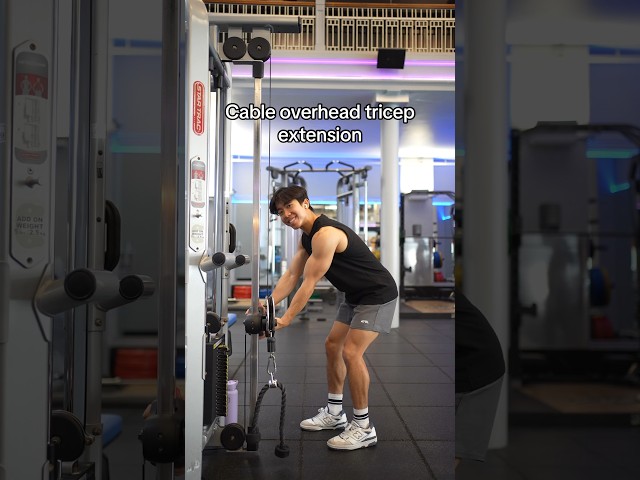
Overhead Cable Extension
Save
Primary
Triceps
Secondary
Shoulders
Equipment
Cable
Difficulty
Beginner
Type
Push
See how Overhead Cable Extension could fit a workout
The example below shows one possible placement. Your purchased plan is built from your assessment, and Ely checks every exercise before approving it.
One-time purchase · Checked by Ely · Delivered in 1–3 business days
This page is not medical advice or a rehabilitation protocol. Ely's personal review applies to purchased workout plans and does not replace an in-person assessment by a licensed healthcare professional.
Cable overhead extensions combine the long head stretch of overhead work with the constant tension of cables. The cable maintains resistance throughout the entire range—including at the fully stretched position behind your head where dumbbells would provide minimal tension. This makes cables potentially superior to free weights for overhead tricep work.
Coaching Note
Face away from the machine and step forward until you feel tension even at full stretch. Keep your elbows pointed forward close to your ears—do not let them flare outward. At the bottom, feel a deep stretch in your triceps before extending back up.
Muscles worked: Overhead Cable Extension
Primary
Secondary
Lateral headMedial headAnconeus
Stabilizers
Why This Exercise Works
The triceps brachii consists of three heads: long, lateral, and medial. The long head is unique because it originates at the scapula (shoulder blade) and crosses the shoulder joint, unlike the lateral and medial heads which only cross the elbow. This anatomical difference means the long head is only fully stretched when your arm is overhead AND the elbow is bent. The cable overhead extension exploits this by combining both positions with constant cable tension throughout the movement. That is why exercise science lists overhead tricep work as essential for complete tricep development — the long head makes up roughly 50% of your total tricep mass, and it only gets fully stimulated when your arm is overhead. EMG studies show significantly higher long head activation in overhead positions compared to pushdown variations where the arm stays by your side. Training muscles in stretched positions (like the bottom of an overhead extension) triggers greater muscle growth signals through mechanical tension, which is consistent with the length-tension relationship — muscles produce more force and receive more growth stimulus when trained in their lengthened position.
Also targets: Shoulders
Want Ely to consider Overhead Cable Extension for your plan?
Share your training details. Ely reviews the full week before anything is delivered.
Overhead Cable Extension form guide
- 1
Set the cable pulley to the lowest position and attach a rope handle.
- 2
Grasp the rope with both hands using a neutral grip, thumbs wrapped around the ends.
- 3
Face away from the machine and step forward 2-3 feet to create tension on the cable.
- 4
Bring your hands behind your head with elbows pointed forward and upper arms close to your ears.
- 5
Brace your core and maintain a slight forward lean at the hips for stability.
- 6
Extend your elbows to press the rope forward and up, keeping your upper arms completely stationary.
- 7
Squeeze your triceps hard at full extension, holding the contraction for one second.
- 8
Control the return to the stretched position behind your head, feeling a deep stretch in the long head.
What are the best tips for the Overhead Cable Extension?
The overhead position maximizes long head stretch under tension — go deep into the stretch on every rep for maximum muscle fiber recruitment.
Keep your elbows pointed forward throughout the entire movement; flaring outward shifts tension away from the long head.
Step further forward from the cable stack to increase starting tension and eliminate any dead zone at the bottom.
Use a staggered stance with one foot forward for better balance during heavy sets or when fatigued.
Focus on the squeeze at lockout — the constant cable tension makes the contracted position highly effective for muscle growth.
When to Use the Overhead Cable Extension
Program cable overhead extensions when long head development is the priority. They pair well with pushdowns which emphasize the lateral head. Use them as your primary tricep isolation movement or as a secondary exercise after compound pressing.
What are common Overhead Cable Extension mistakes to avoid?
Letting elbows flare wide — this shifts tension to the lateral head and significantly reduces long head activation. Keep elbows pointed forward like you are squeezing a tennis ball between them.
Not achieving full stretch behind the head — you miss the primary benefit of overhead tricep work. Lower the rope until you feel a deep stretch.
Arching the lower back excessively — this can cause injury and reduces tricep activation. Brace your core and hinge slightly at the hips instead.
Moving upper arms during the rep — only your forearms should move while upper arms stay completely fixed. If they move, reduce the weight.
Using momentum and swinging the weight — control both the concentric and eccentric phases. Pause briefly at the stretch and contraction positions.
Is the Overhead Cable Extension right for you?
Lifters prioritizing tricep long head development for overall arm size. Anyone whose arms look flat from the side despite pushdown volume. Intermediate trainees ready to move beyond basic pushdowns.
Programming examples for Overhead Cable Extension
The sets, reps, and rest times below are examples. Adjust them for your current ability, the exercise, and your total training. These ranges are not exclusive to one goal.
Example: 3-4 sets of 10-15 reps. Rest 60-90 seconds between sets.
Muscle Growth
10-15 reps
Example rest: 90s-2min; extend as needed
Strength
6-8 reps
Example rest: 2-3min; extend as needed
Endurance
15-20 reps
Example rest: 60s; extend as needed
Where to Use in Your Workout
Place this as your second or third tricep movement after compound pressing. Your triceps are already warm from bench press or overhead press, so you can go straight into working sets. Research programs overhead tricep work in the 10-15 rep range because the long head responds well to higher reps and a deep stretch at the bottom. Exercise science recommends 12-20 sets per week for triceps total (from all exercises). If you are running a push/pull/legs split, that is roughly 4-7 sets per push day. One or two of those sets should be overhead work to make sure the long head is not neglected. Your ideal tricep volume depends on your training split, experience, and how your triceps respond to training. MySetPlan builds this into your personalized program based on your quiz answers.
Sample Workout Blocks
Week 1: 3x12 @ RPE 7 | Week 2: 3x12 @ RPE 8 | Week 3: 4x10 @ RPE 8 | Week 4 (deload): 2x12 @ RPE 6
Want help choosing exercises, sets, and reps for your schedule? Ely reviews purchased plans before delivery.
Get Your Custom PlanWhere Overhead Cable Extension fits in your workout
This is one example of how Overhead Cable Extension could sit inside a complete workout. Your plan may use different movements after Ely checks your assessment.
Sample workout
- Bench Press4 × 8
- Incline Dumbbell Press3 × 10
- Overhead Cable Extension3 × 12
- Overhead Triceps Extension3 × 15
Use this exercise in Gym Mode
MySetPlan guides you set by set, times your rest, records your work, and tells you what to do next from the plan Ely approved.
Start My $19 WeekWhat are good alternatives to the Overhead Cable Extension?
Overhead Tricep Extension
TricepsDumbbellBeginner
Skull Crusher
TricepsEZ BarIntermediate
Tricep Pushdown
TricepsCableBeginner
Kneeling Cable Tricep Extension
TricepsCableIntermediate
Close-Grip Bench Press
ChestBarbellIntermediate
Rope Pushdown
TricepsCableBeginner
Other Variations
- Single Arm Overhead Cable Extension
- Straight Bar Overhead Extension
- Kneeling Cable Extension
- Seated Cable Overhead Extension
- High Cable Overhead Extension
- Cable French Press
Variation Details
Single Arm Cable Overhead Extension
Use this when you notice one tricep is stronger than the other. Train the weaker arm first, then match those reps with your strong arm. Allows you to focus on each arm independently and achieve a slightly greater range of motion. Also useful when the cable station is busy — you only need one handle.
Kneeling Cable Overhead Extension
Kneel on the floor facing away from the cable stack instead of standing. This eliminates lower body involvement and forces stricter form by preventing any leg drive or body sway. Excellent for improving mind-muscle connection and isolating the triceps completely.
Seated Cable Overhead Extension
Sit on a bench facing away from the cable. Similar benefits to kneeling — reduces momentum and focuses tension entirely on the triceps. Position the bench far enough from the stack to maintain tension throughout the entire range of motion.
High Cable Overhead Extension
Set the cable at head height or slightly above instead of the lowest position, then step away facing away from the machine. This changes the resistance angle and can feel more natural for some lifters, especially those with shoulder mobility limitations, while still emphasizing the long head.
EZ-Bar Overhead Extension
Switch to this when you want to go heavier. The fixed grip lets you load more weight than a rope, making it better for lower-rep strength work (6-8 reps). The angled grip of the EZ-bar is easier on the wrists than a straight bar.
Incline Overhead Cable Extension
Set an incline bench facing away from the cable. This changes the angle to increase the stretch on the long head even further. Useful when you want to maximize lengthened-position training for the tricep long head.
Overhead Cable Extension vs Other Exercises
Cables win for muscle growth (hypertrophy) because the tension is constant throughout the rep — there is no resting point. Dumbbells have a dead spot at the top where the weight sits directly over the joint and the muscle gets a break. The cable version provides constant tension throughout the entire range of motion, while dumbbells have variable resistance that is hardest at the bottom and easiest at lockout. Use cables when available, dumbbells when they are not.
Both hit the long head well. The difference is comfort and loading. Cables keep constant tension and are easier on the elbows for most people. Skull crushers let you load heavier and use free weights. If your elbows handle both fine, cables are slightly better for hypertrophy because of the constant tension. If you train at home without cables, skull crushers are your best alternative. Both movements are valuable components in tricep training.
Overhead extensions prioritize the long head (the biggest part of your tricep) because the arm is above your head, stretching the long head at the shoulder. Pushdowns emphasize the lateral head. For complete tricep development, program both — but if you are picking one, overhead extensions develop more total mass because the long head is roughly half your tricep. Neither exercise replaces the other.
Want a plan you do not have to piece together?
Share your goal, schedule, equipment, and experience. Ely checks the complete exercise selection before he approves your week.
Start My $19 Starter Week$19 once · No automatic renewal · Delivered in 1–3 business days
Related Content
Safety Notes
- Keep elbows pointed forward to protect shoulder joints.
- Control the stretch phase — do not let the weight pull your arms back forcefully.
- If you experience shoulder discomfort, try the seated or kneeling variation to reduce the range of motion.