General exercise guide
Pec Deck (Machine Fly)
Save
Primary
Chest
Secondary
Shoulders
Equipment
Machine
Difficulty
Beginner
Type
Push
See how Pec Deck (Machine Fly) could fit a workout
The example below shows one possible placement. Your purchased plan is built from your assessment, and Ely checks every exercise before approving it.
One-time purchase · Checked by Ely · Delivered in 1–3 business days
This page is not medical advice or a rehabilitation protocol. Ely's personal review applies to purchased workout plans and does not replace an in-person assessment by a licensed healthcare professional.
The pec deck offers what dumbbell flyes cannot: constant tension from start to finish. The machine guides your arms through a perfect arc while resistance never lets up, making every inch of the movement productive. It is the simplest way to isolate your chest and build that mind-muscle connection.
Coaching Note
Slow down. Most people rush pec deck and miss the point entirely. Two seconds to close, pause and squeeze for one second, three seconds to open. That tempo transforms a forgettable set into chest-building gold.
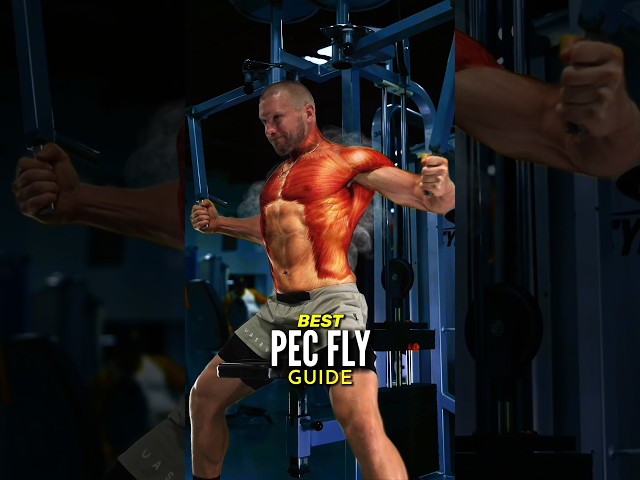
Pec Deck (Machine Fly) — targeted muscles
Why This Exercise Works
The pec deck (machine fly) is an isolation exercise that targets your pectoralis major through horizontal adduction — the action of bringing your arms together in front of your body. Unlike pressing movements that involve tricep extension, the pec deck keeps your elbows in a fixed position, isolating chest contraction as the primary movement.
Your pectoralis major fibers run from your sternum and clavicle toward your upper arm. When you bring your arms together on the pec deck, these fibers shorten and contract. The machine's fixed arm path ensures consistent tension throughout the entire range of motion, which differs from dumbbell flyes where tension decreases at the top of the movement.
The pec deck provides several advantages over free weight flyes. First, the machine maintains constant tension — there's no "rest point" at the top where gravity would reduce muscle activation. Second, the guided path eliminates balance requirements, allowing you to focus entirely on squeezing your chest. Third, the machine is safer near failure because there's no risk of dropping weights.
Your anterior deltoids assist slightly but contribute less than in pressing movements. The pec deck isolates the chest more effectively than pressing because there's no lockout phase where triceps take over. This makes it an excellent finishing exercise for chest workouts when your pressing muscles are fatigued.
The stretch at the bottom of the movement is where the pec deck differs from cables. When your arms are extended to the sides, your chest is fully stretched under load. Research suggests this stretched position contributes significantly to muscle growth. However, don't overextend — going too far back can strain your shoulder joint.
The pec deck's ability to maintain tension throughout the movement makes it ideal for high-rep sets and muscle pump. Combined with compound pressing, the pec deck ensures complete chest fiber recruitment and maximizes hypertrophy stimulus.
Also targets: Shoulders
Want Ely to consider Pec Deck (Machine Fly) for your plan?
Share your training details. Ely reviews the full week before anything is delivered.
How do you perform the Pec Deck (Machine Fly)?
- 1
Adjust the seat so handles are at chest level.
- 2
Sit back against the pad.
- 3
Place your forearms against the pads or grip handles.
- 4
Bring your arms together in front of your chest.
- 5
Squeeze your chest at the peak.
- 6
Return slowly to the starting position.
What are the best tips for the Pec Deck (Machine Fly)?
Focus on the chest squeeze, not the arms.
Don't let your shoulders roll forward.
Control the negative phase.
Don't go too heavy - focus on controlled movement and mind-muscle connection.
When to Use the Pec Deck (Machine Fly)
Pec deck works best at the end of your chest session when pressing strength fades but your pecs can handle more direct work. Use it for pre-exhaustion before bench press if you struggle to feel your chest during pressing. Pairs naturally with any compound press as a superset finisher.
What are common Pec Deck (Machine Fly) mistakes to avoid?
Using too much weight.
Not getting a full squeeze.
Letting weights slam back.
Shoulders rolling forward.
Pec Deck (Machine Fly) — who it's best for
All levels seeking chest isolation. Particularly useful for beginners learning chest engagement and advanced lifters needing high-volume chest work without tricep fatigue.
Programming examples for Pec Deck (Machine Fly)
The sets, reps, and rest times below are examples. Adjust them for your current ability, the exercise, and your total training. These ranges are not exclusive to one goal.
Example: 3-4 sets of 12-15 reps. Rest 60-90s.
Muscle Growth
12-15 reps
Example rest: 90s-2min; extend as needed
Strength
8-10 reps
Example rest: 2-3min; extend as needed
Endurance
15-20 reps
Example rest: 60s; extend as needed
Where to Use in Your Workout
Position at the end of chest workouts after pressing movements to finish the pecs with isolation volume, or use first as a pre-exhaust technique before bench pressing.
Sample Workout Blocks
Week 1: 3x12 @ RPE 7 | Week 2: 3x15 @ RPE 7 | Week 3: 4x12 @ RPE 8 | Week 4 (deload): 2x15 @ RPE 6
Want help choosing exercises, sets, and reps for your schedule? Ely reviews purchased plans before delivery.
Get Your Custom PlanWhere Pec Deck (Machine Fly) fits in your workout
This is one example of how Pec Deck (Machine Fly) could sit inside a complete workout. Your plan may use different movements after Ely checks your assessment.
Sample workout
- Bench Press4 × 8
- Incline Dumbbell Press3 × 10
- Pec Deck (Machine Fly)3 × 12
- Triceps Pushdown3 × 12
Use this exercise in Gym Mode
MySetPlan guides you set by set, times your rest, records your work, and tells you what to do next from the plan Ely approved.
Start My $19 WeekWhat are good alternatives to the Pec Deck (Machine Fly)?
Other Variations
- Reverse Pec Deck (Rear Delts)
Variation Details
Cable Fly
Use cable pulleys instead of the pec deck machine. Cables allow adjustable angles and more natural movement paths. Can be performed standing or on a bench.
Dumbbell Fly
Perform flyes with dumbbells on a bench. Offers a deeper stretch but loses tension at the top. Good for variety and when machines are unavailable.
Machine Fly
Some gyms have separate machine fly equipment that differs from pec deck. Both target the chest through horizontal adduction with similar effectiveness.
Reverse Pec Deck
Turn around on the machine to target your rear deltoids instead of chest. Uses the same equipment for the opposite muscle group.
Pec Deck (Machine Fly) vs Other Exercises
vs Cable Fly
Pec deck offers a fixed path that's easier to learn and maintain. Cable flyes allow more freedom in angle and movement. Both provide constant tension. Use pec deck for stability; use cables for versatility.
vs Dumbbell Fly
Pec deck maintains tension throughout the movement; dumbbell flyes lose tension at the top. Dumbbell flyes offer a deeper stretch at the bottom. Use both for complete chest development.
Want a plan you do not have to piece together?
Share your goal, schedule, equipment, and experience. Ely checks the complete exercise selection before he approves your week.
Start My $19 Starter Week$19 once · No automatic renewal · Delivered in 1–3 business days
Related Content
Safety Notes
- Adjust machine properly.
- Don't use excessive weight.