General exercise guide
Cable Hip Abduction
Save
Primary
Glutes
Secondary
Hip abductors
Equipment
Cable
Difficulty
Beginner
Type
Rotation
See how Cable Hip Abduction could fit a workout
The example below shows one possible placement. Your purchased plan is built from your assessment, and Ely checks every exercise before approving it.
One-time purchase · Checked by Ely · Delivered in 1–3 business days
This page is not medical advice or a rehabilitation protocol. Ely's personal review applies to purchased workout plans and does not replace an in-person assessment by a licensed healthcare professional.
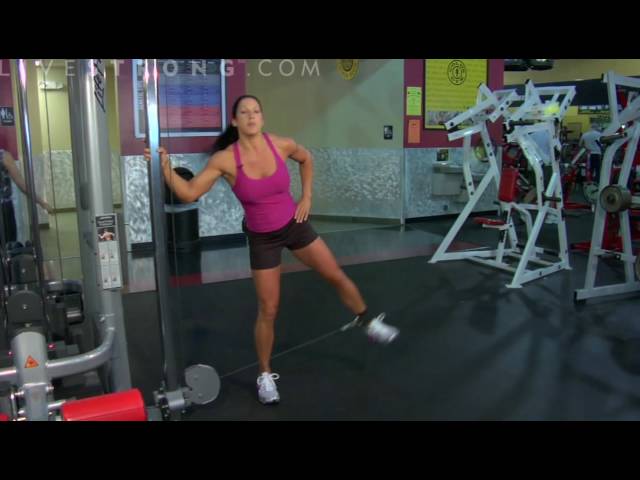
The cable hip abduction lifts your leg away from your body against cable resistance, targeting the gluteus medius and hip abductors. Standing on one leg while abducting the other adds a balance component that machine abduction lacks. The cable provides constant tension throughout the range.
When to use it
Use as an accessory for glute medius development.
Who it's for
All levels wanting direct glute medius work.
Coaching Note
Stand sideways to the cable with the ankle strap on your outside leg. Keep your standing leg slightly bent and your posture upright. Lift your outside leg away from your body, then control the return. Do not lean excessively to lift higher.
Muscles worked: Cable Hip Abduction
Also targets: hip abductors
Want Ely to consider Cable Hip Abduction for your plan?
Share your training details. Ely reviews the full week before anything is delivered.
Cable Hip Abduction form guide
- 1
Attach an ankle strap to a low cable.
- 2
Stand sideways to the machine.
- 3
Secure the strap to your outside ankle.
- 4
Hold the machine for stability.
- 5
Lift your outside leg away from your body.
- 6
Control the return against resistance.
What are the best tips for the Cable Hip Abduction?
Keep your standing leg slightly bent.
Maintain upright posture.
Focus on the outer glute contraction.
When to Use the Cable Hip Abduction
Program cable hip abduction for gluteus medius development when you want more challenge than bands or when machines are unavailable. Use moderate to high reps with controlled tempo. They pair well with other cable glute exercises.
What are common Cable Hip Abduction mistakes to avoid?
Leaning excessively to the side.
Rotational exercises like the Cable Hip Abduction generate force through your midsection. This mistake reduces control and can shift work away from your Glutes (gluteus medius). Move deliberately through the intended range.
Using momentum to swing the leg.
Bouncing or using momentum during the Cable Hip Abduction makes the movement harder to control and can shift work away from your Glutes (gluteus medius). Use a load you can move smoothly through the intended range.
Not controlling the eccentric.
Rotational exercises like the Cable Hip Abduction generate force through your midsection. This mistake reduces control and can shift work away from your Glutes (gluteus medius). Move deliberately through the intended range.
Is the Cable Hip Abduction right for you?
All levels wanting direct glute medius work.
Programming examples for Cable Hip Abduction
These ranges illustrate ways to organize training. They are not an individual prescription. Adjust them for the exercise, your experience, and the rest of your program.
Strength8-10 reps per leg
Heavier loads can be useful for developing maximum strength. The range shown is an example, and the load must match your current technique and capacity.
Muscle Growth12-15 reps per leg
Muscle growth can occur across different loads and repetition ranges. This example is not a uniquely effective zone; your overall program and effort also matter.
Endurance15-20 reps per leg
This is an example of a longer set. A repetition target alone does not establish joint safety or whether the exercise is appropriate for you.
Example: 3 sets of 12-15 reps per leg. Rest 45s.
Background for resistance exercises: the 2026 ACSM position stand covers healthy adults, and a load-comparison review found similar muscle growth across loads in studies using sets taken to muscular failure. These findings do not validate every exercise-specific range shown here or require training to failure.
Where Cable Hip Abduction fits in your workout
This is one example of how Cable Hip Abduction could sit inside a complete workout. Your plan may use different movements after Ely checks your assessment.
Sample workout
- Squat or Leg Press4 × 8
- Romanian Deadlift3 × 10
- Cable Hip Abduction3 × 12
- Calf Raise3 × 15
Use this exercise in Gym Mode
MySetPlan guides you set by set, times your rest, records your work, and tells you what to do next from the plan Ely approved.
Start My $19 WeekWhat are good alternatives to the Cable Hip Abduction?
Other Variations
- Banded Hip Abduction
- Machine Hip Abduction
Want a plan you do not have to piece together?
Share your goal, schedule, equipment, and experience. Ely checks the complete exercise selection before he approves your week.
Start My $19 Starter Week$19 once · No automatic renewal · Delivered in 1–3 business days
Related Content
Safety Notes
- Use appropriate weight.
- Control the movement throughout.