Content updated September 2026
Barbell Row
Save
Primary
Back
Secondary
Biceps, Rear deltoids, Core
Equipment
Barbell
Difficulty
Intermediate
Type
Pull
See how Barbell Row could fit a workout
The example below shows one possible placement. Your purchased plan is built from your assessment, and Ely checks every exercise before approving it.
One-time purchase · Checked by Ely · Delivered in 1–3 business days
This page is not medical advice or a rehabilitation protocol. Ely's personal review applies to purchased workout plans and does not replace an in-person assessment by a licensed healthcare professional.
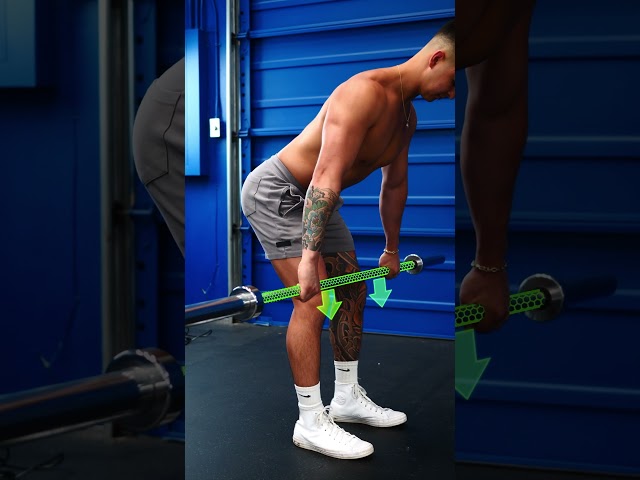
The barbell row is the horizontal pulling counterpart to deadlifts and squats—a heavy compound that builds back thickness. You hinge forward, grip a loaded barbell, and row it to your lower chest. Your lats, rhomboids, traps, and spinal erectors all work together under serious load.
Coaching Note
Your lower back must stay flat or slightly arched—never rounded. If your back rounds, the weight is too heavy. Pull to your lower chest, not your belly. The bar path should travel toward your sternum, not your navel.
What muscles does the Barbell Row work?
Secondary
Stabilizers
Why This Exercise Works
The barbell row is a horizontal pull that builds back thickness — the front-to-back mass that makes your back look three-dimensional. Your latissimus dorsi (lats) are the primary movers, pulling your upper arm down and back toward your body. But unlike vertical pulls (pull-ups, lat pulldowns), the row angle heavily recruits your rhomboids and mid-traps, which squeeze your shoulder blades together at the top of each rep.
Your rear deltoids fire significantly during rows, more than during most dedicated rear delt exercises. Research has shown that heavy rowing is one of the most effective ways to build rear delts without additional isolation work. If you row heavy and frequently, you may not need face pulls or reverse flyes at all.
The isometric demand on your erector spinae (lower back muscles) is massive. You're holding a hinged position under load for the entire set. This is both a benefit and a limitation — rows build lower back endurance and strength, but your spinal erectors often fatigue before your lats do on heavy sets. This is why strict form matters: the moment your back rounds, the load shifts from your lats to your spine.
Your biceps work as secondary movers throughout the pull. EMG data shows bicep activation during barbell rows is comparable to moderate-intensity curls, which is why many programs count row volume toward total bicep work. Your forearms grip the bar isometrically — heavy rows are one of the best grip builders in the gym.
Row angle changes muscle emphasis. A more upright torso (around 45-60 degrees) targets upper back and traps more. A nearly horizontal torso (Pendlay row style) hits the lats harder and demands more from the lower back. Finding the angle where you feel the strongest lat contraction and standardizing it is recommended, as strength researcher Greg Nuckols has documented.
Where you pull the bar matters too. Pulling to your lower chest emphasizes lats; pulling to your upper abdomen shifts more work to rhomboids and mid-traps. Most lifters benefit from pulling to the lower chest for maximum lat development.
Want Ely to consider Barbell Row for your plan?
Share your training details. Ely reviews the full week before anything is delivered.
Step-by-step: Barbell Row
- 1
Stand with feet hip-width apart.
- 2
Hinge at hips, keeping back flat.
- 3
Grip barbell with overhand grip.
- 4
Pull bar to lower chest.
- 5
Squeeze shoulder blades together.
- 6
Lower with control for optimal results.
What are the best tips for the Barbell Row?
Keep your back flat throughout.
Don't round your lower back.
Row to lower chest for full contraction.
Control the negative.
When to Use the Barbell Row
Place barbell rows early in your back workout when spinal fatigue is low and you can maintain strict form. Works well after deadlifts or as your primary back movement. For back thickness, nothing beats heavy rowing.
What are common Barbell Row mistakes to avoid?
Rounding the back for optimal results.
Using too much body English.
Not squeezing at the top.
Rowing to belly instead of chest.
Who should do the Barbell Row?
Intermediate to advanced for optimal results.
Programming examples for Barbell Row
The sets, reps, and rest times below are examples. Adjust them for your current ability, the exercise, and your total training. These ranges are not exclusive to one goal.
Example: 3-4 sets of 8-10 reps. Rest 90s.
Muscle Growth
8-12 reps
Example rest: 90s-2min; extend as needed
Strength
5-6 reps
Example rest: 2-3min; extend as needed
Endurance
12-15 reps
Example rest: 60s; extend as needed
Where to Use in Your Workout
Program as your primary horizontal pull early in back workouts. If paired with deadlifts, place rows second. If deadlifts are on a different day, rows can be your first movement. Follow with vertical pulls (pull-ups, lat pulldowns) for complete back development.
Sample Workout Blocks
Strength: 4x6 @ RPE 8 (2-3 min rest) | Hypertrophy: 3-4x8-12 @ RPE 7-8 (90s-2 min rest) | Pendlay variation: 5x5 with full reset each rep for explosive power
Want help choosing exercises, sets, and reps for your schedule? Ely reviews purchased plans before delivery.
Get Your Custom PlanWhere Barbell Row fits in your workout
This is one example of how Barbell Row could sit inside a complete workout. Your plan may use different movements after Ely checks your assessment.
Sample workout
- Lat Pulldown4 × 8
- Row Variation3 × 10
- Barbell Row3 × 12
- Face Pull3 × 15
Use this exercise in Gym Mode
MySetPlan guides you set by set, times your rest, records your work, and tells you what to do next from the plan Ely approved.
Start My $19 WeekWhat are good alternatives to the Barbell Row?
Other Variations
- Pendlay Row
- Underhand Row
- T-Bar Row
Variation Details
Dumbbell Row
Single-arm version with one hand braced on a bench. Removes lower back as a limiting factor and fixes left-right imbalances. Use when your lower back fatigues before your lats.
T-Bar Row
Uses a landmine attachment or T-bar machine. The fixed bar path makes it easier to focus on squeezing your back. Good middle ground between barbell and machine rows.
Pendlay Row
Strict version where the bar rests on the floor between each rep. Builds explosive pulling power. Use when you want to train back strength without momentum.
Seated Cable Row
Eliminates lower back as a factor entirely. Constant cable tension throughout the movement. Use as a finisher or when your lower back can't handle more free-weight rowing.
Barbell Row vs Other Exercises
vs Dumbbell Row
Barbell rows are heavier and train both sides together — better for overall back strength. Dumbbell rows isolate each side and spare your lower back. Use barbell rows as your primary heavy pull; use dumbbell rows to fix imbalances or when your lower back needs a break.
vs T-Bar Row
T-bar rows offer a more fixed path and are slightly easier on the lower back. Barbell rows demand more stabilization and allow more loading. Both build excellent back thickness. Rotate between them every 4-6 weeks to prevent adaptation.
Want a plan you do not have to piece together?
Share your goal, schedule, equipment, and experience. Ely checks the complete exercise selection before he approves your week.
Start My $19 Starter Week$19 once · No automatic renewal · Delivered in 1–3 business days
Related Content
Safety Notes
- Keep back flat.
- Don't round spine.
Related Workout Plan Guides
Compare This Exercise
Barbell Row vs Dumbbell Row
Barbell rows allow heavier loads for strength, while dumbbell rows address imbalances and offer greater range of motion. Both are excellent back builders.
Barbell Row vs Seated Cable Row
Cable rows provide constant tension throughout the movement, while barbell rows allow heavier loading and engage more stabilizers. Both build back muscle effectively through different mechanisms.
Barbell Row vs Seated Cable Row
Seated rows provide back support and pure horizontal pulling, while barbell rows challenge your entire posterior chain. Use seated rows for isolation, barbell rows for compound strength.
Barbell Row vs T-Bar Row
T-bar rows offer stability and neutral grip options for comfortable heavy rowing, while barbell rows allow maximum loading and greater lat stretch. Both build back thickness effectively.