Content updated September 2026
Barbell Hip Thrust
Save
Primary
Glutes
Secondary
Hamstrings, Core
Equipment
Barbell
Difficulty
Intermediate
Type
Hinge
See how Barbell Hip Thrust could fit a workout
The example below shows one possible placement. Your purchased plan is built from your assessment, and Ely checks every exercise before approving it.
One-time purchase · Checked by Ely · Delivered in 1–3 business days
This page is not medical advice or a rehabilitation protocol. Ely's personal review applies to purchased workout plans and does not replace an in-person assessment by a licensed healthcare professional.
The barbell hip thrust is the gold standard for glute hypertrophy, loading your glutes heavily through full hip extension with your back supported on a bench. Unlike squats and deadlifts where glutes share work with other muscles, hip thrusts isolate glute contraction at the top where activation is highest. This makes them uniquely effective for building maximum glute size and strength.
Coaching Note
Drive through your heels and think about pushing the floor away as you thrust upward. At the top, your shins should be vertical and your body should form a straight line from knees to shoulders. Squeeze your glutes hard and hold briefly before lowering.
Barbell Hip Thrust — targeted muscles
Why This Exercise Works
The barbell hip thrust produces the highest gluteus maximus activation of any resistance exercise — higher than squats, deadlifts, or lunges, as Bret Contreras's glute activation research has confirmed. Peak glute EMG activity occurs during hip thrusts, particularly at the top of the movement where your hips are fully extended. This is the opposite of squats, where glute activation peaks at the bottom.
Your gluteus maximus is a massive muscle — the largest in your body — and it's responsible for hip extension, external rotation, and posterior pelvic tilt. The hip thrust trains all three functions simultaneously. At the top of each rep, your glutes contract maximally to push your hips toward the ceiling while your pelvis tilts posteriorly (tucking your tailbone). This end-range contraction is unique to hip thrusts and is why they're superior for glute-specific hypertrophy.
Your gluteus medius and minimus (the smaller side glutes) act as stabilizers to prevent your knees from caving inward. Wrapping a resistance band around your knees during hip thrusts turns these stabilizers into active movers, making it a more complete glute exercise.
Your hamstrings assist as hip extensors, but their contribution is minimized compared to movements like RDLs because your knees are bent at 90 degrees. This shortened hamstring position reduces their ability to produce force, pushing more work onto the glutes. This is intentional — the hip thrust is designed to isolate glutes as much as a compound movement can.
Your quadriceps work minimally, primarily to stabilize the knee joint. Your core braces isometrically to maintain a neutral spine under the barbell. Your erector spinae are significantly less loaded compared to deadlifts or squats because the force vector is horizontal (the bar presses into your hips, not down through your spine).
Hip thrusts are programmed as the primary glute exercise in hypertrophy blocks, typically for 3-4 sets of 10-15 reps, as Dr. Mike Israetel's Renaissance Periodization research recommends. Glutes respond particularly well to higher rep ranges and going too heavy (under 6 reps) often leads to compensating with your lower back.
The bench height matters more than most people realize. Your upper back should rest on a bench that puts your shoulder blades at roughly bench height (16-18 inches). Too high and you'll struggle to achieve full hip extension; too low and the movement arc changes, reducing glute activation.
Also targets: Hamstrings, Core
Want Ely to consider Barbell Hip Thrust for your plan?
Share your training details. Ely reviews the full week before anything is delivered.
How do you perform the Barbell Hip Thrust?
- 1
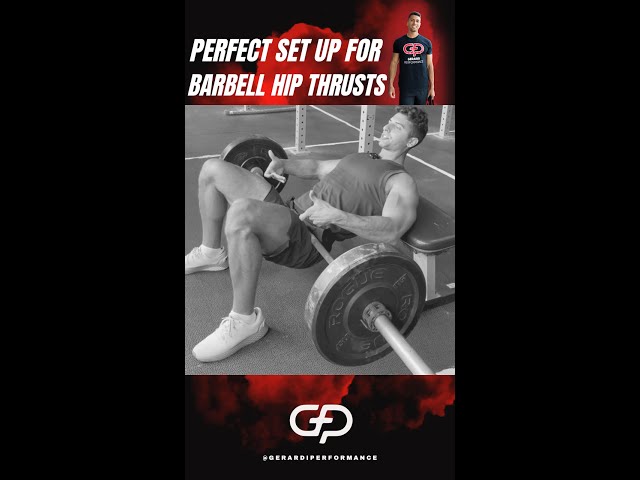
Sit on the floor with your upper back against a bench and a barbell across your hips.
- 2
Roll the barbell over your legs until it rests in your hip crease.
- 3
Plant your feet flat on the floor, hip-width apart.
- 4
Drive through your heels and thrust your hips upward until your body forms a straight line.
- 5
Squeeze your glutes hard at the top and hold briefly.
- 6
Lower your hips back down with control.
What are the best tips for the Barbell Hip Thrust?
Use a barbell pad for comfort on your hips.
Keep your chin tucked throughout the movement.
Drive through your heels, not your toes.
Avoid hyperextending your lower back at the top.
When to Use the Barbell Hip Thrust
Program barbell hip thrusts as your primary glute exercise, typically early in your workout when fresh. Use them 2-3 times per week for glute development. They pair well with leg curls to train both hip extension and knee flexion functions of the hamstrings.
What are common Barbell Hip Thrust mistakes to avoid?
Pushing through toes instead of heels.
Overarching the lower back at the top.
Not achieving full hip extension.
Barbell Hip Thrust — who it's best for
Intermediate to advanced lifters seeking maximum glute development.
Programming examples for Barbell Hip Thrust
The sets, reps, and rest times below are examples. Adjust them for your current ability, the exercise, and your total training. These ranges are not exclusive to one goal.
Example: 3-4 sets of 8-12 reps. Rest 90s-2min between sets.
Muscle Growth
8-12 reps
Example rest: 90s-2min; extend as needed
Strength
4-6 reps
Example rest: 2-3min; extend as needed
Endurance
15-20 reps
Example rest: 60s; extend as needed
Where to Use in Your Workout
Program as your primary glute exercise early in lower body workouts. Can be placed before or after squats depending on priority — if glute growth is the goal, hip thrust first. Follow with RDLs or lunges for additional glute and hamstring work.
Sample Workout Blocks
Hypertrophy: 3-4x10-15 @ RPE 8 with 2s hold at top (90s rest) | Strength: 4x6-8 @ RPE 8-9 (2 min rest) | Glute activation: 2x20 with band @ bodyweight before squats
Want help choosing exercises, sets, and reps for your schedule? Ely reviews purchased plans before delivery.
Get Your Custom PlanWhere Barbell Hip Thrust fits in your workout
This is one example of how Barbell Hip Thrust could sit inside a complete workout. Your plan may use different movements after Ely checks your assessment.
Sample workout
- Squat or Leg Press4 × 8
- Romanian Deadlift3 × 10
- Barbell Hip Thrust3 × 12
- Calf Raise3 × 15
Use this exercise in Gym Mode
MySetPlan guides you set by set, times your rest, records your work, and tells you what to do next from the plan Ely approved.
Start My $19 WeekWhat are good alternatives to the Barbell Hip Thrust?
Glute Bridge
GlutesBodyweightBeginner
Cable Pull-Through
GlutesCableIntermediate
Kettlebell Swing
GlutesKettlebellIntermediate
Other Variations
Variation Details
Glute Bridge
Floor version without a bench. Easier to set up and safer for beginners. Less range of motion than hip thrusts, so less glute stretch at the bottom.
Single-Leg Hip Thrust
One leg at a time. Fixes left-right imbalances and doubles the challenge without adding weight. Use when you don't have heavy weights available.
Banded Hip Thrust
Resistance band adds tension at the top where glutes are strongest. Great warm-up or finisher. Can be combined with barbell for maximum tension throughout the movement.
Cable Pull-Through
Standing hip hinge with cable between legs. Constant tension and easier to learn than hip thrusts. Good alternative when benches are taken.
Barbell Hip Thrust vs Other Exercises
vs Glute Bridge
Glute bridges use the same pattern but from the floor — less range of motion and less glute stretch at the bottom. Hip thrusts with a bench allow deeper hip flexion, which means more muscle stimulus. Use bridges as a warm-up or when you don't have a bench; use hip thrusts as your primary glute builder.
Cable pull-throughs train the hip hinge standing up with constant cable tension. Hip thrusts load heavier and produce more peak glute activation at lockout. Use pull-throughs for warm-ups or when benches are taken; use hip thrusts for maximum glute development.
Want a plan you do not have to piece together?
Share your goal, schedule, equipment, and experience. Ely checks the complete exercise selection before he approves your week.
Start My $19 Starter Week$19 once · No automatic renewal · Delivered in 1–3 business days
Related Content
Safety Notes
- Use a pad to protect your hips.
- Start with lighter weight to master form.
- Avoid excessive spinal extension.