Content updated September 2026
Barbell Bench Press
Save
Primary
Chest
Secondary
Triceps, Shoulders
Equipment
Barbell
Difficulty
Intermediate
Type
Push
See how Barbell Bench Press could fit a workout
The example below shows one possible placement. Your purchased plan is built from your assessment, and Ely checks every exercise before approving it.
One-time purchase · Checked by Ely · Delivered in 1–3 business days
This page is not medical advice or a rehabilitation protocol. Ely's personal review applies to purchased workout plans and does not replace an in-person assessment by a licensed healthcare professional.
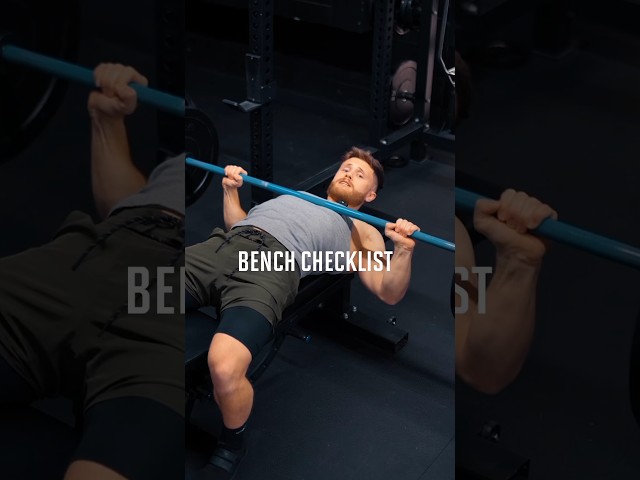
The barbell bench press is a horizontal pressing exercise performed on a flat bench. You control a free bar rather than following a machine rail. This guide covers the setup, muscles involved, and a sample session; it does not assess whether the movement is right for an individual.
Coaching Note
Before unracking, check the bench and rack, establish your grip, and agree with your spotter on when to assist. Practice with a manageable load before increasing it.
Barbell Bench Press — targeted muscles
Primary
Stabilizers
CoreRotator cuff
Why This Exercise Works
The chest and front shoulders contribute to moving the upper arms, while the triceps extend the elbows. A stalled repetition does not, by itself, identify a single muscle as the cause.
A 2024 study combined recordings from ten experienced lifters using a 16 kg bar with a musculoskeletal model. Grip width and shoulder-blade position changed estimated shoulder-joint loads. Several modeled loads were lower with narrower grips and retracted shoulder blades. The study did not measure actual injuries over time and cannot identify a grip appropriate for every lifter.
The 2026 ACSM position stand supports progressive resistance training for healthy adults. Heavier loading can help maximum strength, while muscle growth depends on more than a named repetition zone. The findings do not require a particular chest exercise in every program.
Want Ely to consider Barbell Bench Press for your plan?
Share your training details. Ely reviews the full week before anything is delivered.
How do you perform the Barbell Bench Press?
- 1
Lie flat on a bench with feet firmly on the floor.
- 2
Grip the barbell slightly wider than shoulder-width.
- 3
Unrack the bar and position it over your chest.
- 4
Lower the bar with control to your mid-chest.
- 5
Press the bar back up to full arm extension.
- 6
Keep your shoulder blades retracted throughout.
What are the best tips for the Barbell Bench Press?
Keep your head, shoulders, and buttocks supported on the bench.
Keep your feet flat and drive through them.
Touch the bar to your chest - don't bounce.
Use a closed grip with your thumbs around the bar; control the descent.
When to Use the Barbell Bench Press
If improving the bench press is a priority, you can place it early in a session. Account for other pressing work when deciding how many sets to include. A plan does not need bench press, incline press, and flyes in every workout.
What are common Barbell Bench Press mistakes to avoid?
Flaring elbows too wide (90 degrees).
Bouncing the bar off the chest.
Lifting hips off the bench.
Not retracting shoulder blades.
Barbell Bench Press — who it's best for
People who can set up and control a barbell press. The intermediate label describes the coordination demands; it is not a prerequisite test.
Programming examples for Barbell Bench Press
The sets, reps, and rest times below are examples. Adjust them for your current ability, the exercise, and your total training. These ranges are not exclusive to one goal.
Example: Illustrative session: 2 sets of 8 controlled reps after warming up. Rest 2-3 minutes, or longer if needed. Choose a manageable load and adjust the example to your program.
Muscle Growth
6-12 reps
Example rest: 90s-2min; extend as needed
Strength
1-5 reps
Example rest: 2-3min; extend as needed
Endurance
12-15 reps
Example rest: 60s; extend as needed
Where to Use in Your Workout
Place bench press early if practicing it is your priority. Consider the rest of the session before adding more pressing sets.
Sample Workout Blocks
Illustrative session: warm up, then 2 sets of 8 controlled reps with a manageable load. Rest 2-3 minutes or longer as needed. Record the load and completed reps. Repeating the same load is an option; a calendar date alone does not require an increase or a deload.
Want help choosing exercises, sets, and reps for your schedule? Ely reviews purchased plans before delivery.
Get Your Custom PlanWhere Barbell Bench Press fits in your workout
This is one example of how Barbell Bench Press could sit inside a complete workout. Your plan may use different movements after Ely checks your assessment.
Sample workout
- Bench Press4 × 8
- Incline Dumbbell Press3 × 10
- Barbell Bench Press3 × 12
- Triceps Pushdown3 × 12
Use this exercise in Gym Mode
MySetPlan guides you set by set, times your rest, records your work, and tells you what to do next from the plan Ely approved.
Start My $19 WeekWhat are good alternatives to the Barbell Bench Press?
Dumbbell Bench Press
ChestDumbbellBeginner
Machine Chest Press
ChestMachineBeginner
Push-Up
ChestBodyweightBeginner
Other Variations
- Close Grip Bench
- Wide Grip Bench
- Pause Bench
- Spoto Press
Variation Details
Incline Barbell Bench Press
Press with the head end of the bench raised. Check the separate setup instructions.
Decline Bench Press
Press on a decline bench with the head end lower. This needs a suitable bench and setup.
Close-Grip Bench Press
A barbell press using a narrower hand position.
Dumbbell Bench Press
Press separate weights in each hand rather than a shared bar.
Push-Up
A pressing movement using body weight and a support surface.
Barbell Bench Press vs Other Exercises
The bar connects both hands; dumbbells let each hand move separately. Available weight increments and the setup differ. Neither choice automatically corrects an imbalance or belongs exclusively to one training goal.
A machine guides the movement along its designed path. A barbell requires you to control the bar and plan how to end a failed repetition. Check the particular machine or rack setup rather than assuming one equipment type is always safer.
vs Push-Up
Push-ups use body weight and a support surface; bench press uses an external barbell load. Choose according to your available equipment and the movement you want to practice.
Sources and limits
- ACE bench-press assessment protocol (2020, PDF)
Technique and spotting reference. Its maximal-strength testing procedure is separate from the illustrative session on this page.
- Noteboom et al.: bench technique and modeled shoulder loads (2024)
Small laboratory study of experienced lifters; modeled loads are not proof of injury prevention.
- ACSM resistance-training position stand (2026)
Training principles for healthy adults. It does not prescribe the sample session or an individual rehabilitation program.
Want a plan you do not have to piece together?
Share your goal, schedule, equipment, and experience. Ely checks the complete exercise selection before he approves your week.
Start My $19 Starter Week$19 once · No automatic renewal · Delivered in 1–3 business days
Related Content
Safety Notes
- Always use a spotter for heavy sets.
- Set safety bars at appropriate height.
- Don't lift off without proper setup.
Related Workout Plan Guides
Compare This Exercise
Barbell Bench Press vs Dumbbell Bench Press
Dumbbell bench press offers greater range of motion and muscle balance, while barbell bench press allows heavier loads for strength. Use both for optimal chest development.
Barbell Bench Press vs Overhead Press (Barbell)
Overhead press builds shoulder strength and overhead stability, while bench press develops chest and tricep power. Both are essential for balanced upper body development.
Barbell Bench Press vs Incline Barbell Bench Press
Incline bench targets upper chest and front delts more, while flat bench allows heavier loads for overall chest mass. Use both for complete chest development.
Barbell Bench Press vs Dumbbell Fly
Bench press builds overall chest strength and mass, while dumbbell flyes isolate the pecs with a greater stretch. Use both for complete chest development.