Content updated September 2026
Arnold Press
Save
Primary
Shoulders
Secondary
Triceps, Upper chest
Equipment
Dumbbell
Difficulty
Intermediate
Type
Push
See how Arnold Press could fit a workout
The example below shows one possible placement. Your purchased plan is built from your assessment, and Ely checks every exercise before approving it.
One-time purchase · Checked by Ely · Delivered in 1–3 business days
This page is not medical advice or a rehabilitation protocol. Ely's personal review applies to purchased workout plans and does not replace an in-person assessment by a licensed healthcare professional.
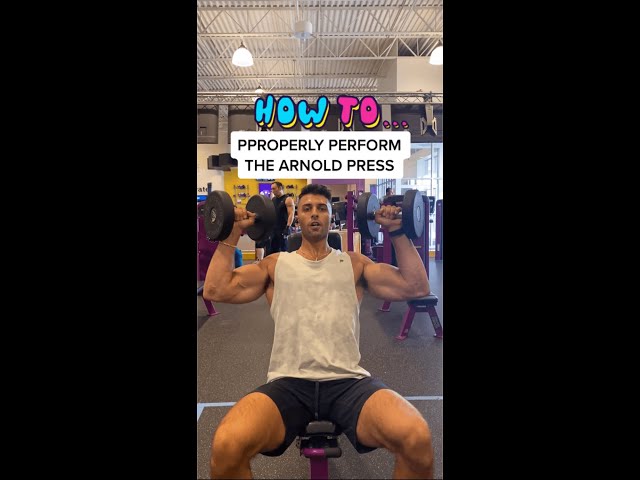
The Arnold press adds rotation to a standard dumbbell press—you start with palms facing you and rotate to palms forward as you press. This rotation recruits all three deltoid heads through a longer range of motion. Named after Arnold Schwarzenegger.
Coaching Note
Start with dumbbells at shoulder height, palms facing you. As you press up, rotate your palms to face forward. The rotation should be smooth and continuous, finishing as you lock out. Reverse on the way down.
What muscles does the Arnold Press work?
Why This Exercise Works
The Arnold press is unique among shoulder pressing movements because the rotational component recruits all three deltoid heads through a single continuous movement. The exercise begins with palms facing you (supinated), which places the anterior deltoid in a pre-stretched position similar to a front raise. As you press and rotate to palms forward (pronated), the lateral deltoid progressively takes over, and the posterior deltoid assists with stabilization through the arc of rotation.
The anterior deltoid does the heaviest work during the bottom-to-mid portion of the press where the palms are transitioning. The lateral deltoid peaks in activation during the upper portion as your arms move into the overhead pressing plane. EMG analysis shows the Arnold press produces higher lateral deltoid activation compared to standard dumbbell presses, as Jeff Nippard has noted in his evidence-based shoulder training reviews. This makes it one of the few pressing movements that meaningfully targets side delts.
The rotational component also increases time under tension compared to a straight press. The longer movement arc means each rep takes more time, and the muscles are loaded through a greater range of motion. Dr. Mike Israetel has highlighted that this extended ROM is valuable for hypertrophy because more mechanical work is performed per repetition. However, the rotation demands lighter loads — most lifters use 20-30% less weight than their standard dumbbell shoulder press.
The upper portion of the trapezius assists during the overhead lockout phase, while the triceps contribute to the final pressing motion. The rotator cuff muscles — particularly the infraspinatus and teres minor — work throughout to control the humeral rotation. This makes the Arnold press a surprisingly complete upper body movement.
Browse all shoulders exercises
Also targets: Triceps, upper chest
Want Ely to consider Arnold Press for your plan?
Share your training details. Ely reviews the full week before anything is delivered.
Step-by-step: Arnold Press
- 1
Sit with dumbbells at shoulder height, palms facing you.
- 2
As you press up, rotate your palms to face forward.
- 3
Complete the rotation as you lock out overhead.
- 4
Reverse the rotation as you lower.
- 5
Return to the starting position with palms facing you.
What are the best tips for the Arnold Press?
Named after Arnold Schwarzenegger.
The rotation hits all three deltoid heads.
Control the rotation throughout.
Don't rush the movement.
When to Use the Arnold Press
Use Arnold presses when you want complete deltoid stimulation in one exercise. The rotation makes them harder than standard presses, so use lighter weight. Good as a primary press or after heavier straight pressing.
What are common Arnold Press mistakes to avoid?
Rotating too early or late.
Using too much weight.
Rushing through the rotation.
Who should do the Arnold Press?
Intermediate lifters looking to progress their training.
Programming examples for Arnold Press
The sets, reps, and rest times below are examples. Adjust them for your current ability, the exercise, and your total training. These ranges are not exclusive to one goal.
Example: 3-4 sets of 8-12 reps. Rest 90s.
Muscle Growth
8-12 reps
Example rest: 90s-2min; extend as needed
Strength
6-8 reps
Example rest: 2-3min; extend as needed
Endurance
12-15 reps
Example rest: 60s; extend as needed
Where to Use in Your Workout
Use as your primary dumbbell shoulder press or as a secondary pressing movement after barbell overhead press. The higher time under tension makes it better suited for moderate rep ranges. Follow with lateral raise isolation work.
Sample Workout Blocks
Hypertrophy: 3x10-12 @ RPE 7-8 (90s rest) | Moderate: 4x8 @ RPE 8 (2 min rest) | Expect to use 20-30% less weight than standard dumbbell press
Want help choosing exercises, sets, and reps for your schedule? Ely reviews purchased plans before delivery.
Get Your Custom PlanWhere Arnold Press fits in your workout
This is one example of how Arnold Press could sit inside a complete workout. Your plan may use different movements after Ely checks your assessment.
Sample workout
- Overhead Press4 × 8
- Lateral Raise3 × 12
- Arnold Press3 × 12
- Face Pull3 × 15
Use this exercise in Gym Mode
MySetPlan guides you set by set, times your rest, records your work, and tells you what to do next from the plan Ely approved.
Start My $19 WeekWhat are good alternatives to the Arnold Press?
Dumbbell Shoulder Press
ShouldersDumbbellBeginner
Overhead Press (Barbell)
ShouldersBarbellIntermediate
Other Variations
- Standing Arnold Press
- Single-Arm Arnold Press
Variation Details
Standing Arnold Press
Perform standing instead of seated. Adds core stability demand but limits the weight you can use. Good for athletic training.
Single-Arm Arnold Press
One arm at a time. Increases core anti-rotation demand and lets you focus on each side independently. Good for fixing asymmetry.
Seated Arnold Press
Back support version that lets you isolate shoulders more. The most common variation for muscle building.
Dumbbell Shoulder Press
Standard press without rotation. Allows heavier loading for pure pressing strength.
Arnold Press vs Other Exercises
Standard dumbbell press allows heavier loads and is better for pure strength. Arnold press hits all three delt heads through the rotation and builds more balanced shoulders. Use standard presses for heavy work, Arnold presses for hypertrophy and complete deltoid coverage.
Barbell overhead press is the strongest pressing variation and best for strength progression. Arnold press offers more deltoid variety through rotation but with lighter loads. Use overhead press as your primary strength builder, Arnold press for hypertrophy variety.
Lateral raises are pure isolation for side delts. Arnold press is a compound movement that hits side delts through pressing plus rotation. Use Arnold presses for efficient compound training, add lateral raises for dedicated side delt volume.
Want a plan you do not have to piece together?
Share your goal, schedule, equipment, and experience. Ely checks the complete exercise selection before he approves your week.
Start My $19 Starter Week$19 once · No automatic renewal · Delivered in 1–3 business days
Related Content
Safety Notes
- Use lighter weight than regular presses.
- Control the rotation.