Dumbbell RDL
Primary
Hamstrings
Secondary
Glutes, Lower Back, Core
Equipment
Dumbbell
Difficulty
Intermediate
Type
Hinge
NASM-CPT, CSCS certified trainers. Every guide is built from peer-reviewed research and real coaching experience.
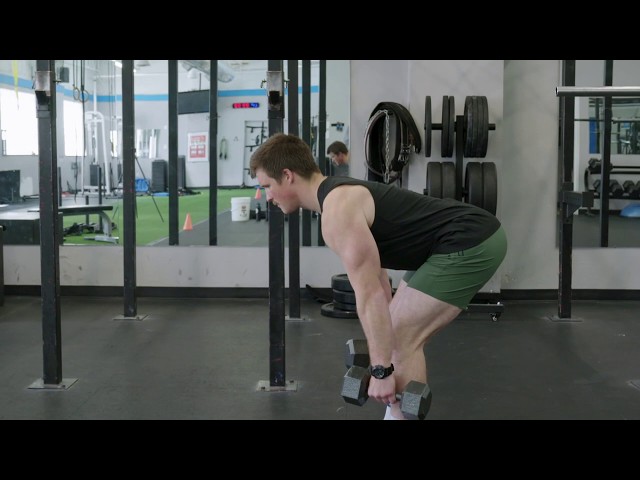
The dumbbell RDL brings the Romanian deadlift pattern to lifters without barbell access, using two dumbbells at your sides instead. The independent weights allow a more natural arm path and may reduce lower back stress for some lifters compared to the fixed barbell position. This makes dumbbell RDLs excellent for home gyms and as a variation from barbell work.
Keep the dumbbells close to your legs—they should nearly brush your thighs and shins during the movement. Push your hips back while maintaining a flat back. The dumbbells hanging at your sides rather than in front may feel different from barbells, so adjust your balance.
What muscles does the Dumbbell RDL work?
Why This Exercise Works
The dumbbell Romanian deadlift is a hip hinge movement that primarily targets the hamstrings through eccentric (lengthening) loading. As you lower the dumbbells, the hamstrings must control the descent while stretching under tension — this eccentric emphasis makes RDLs exceptionally effective for hamstring hypertrophy and injury prevention. The gluteus maximus works powerfully during the hip extension phase as you return to standing. Unlike conventional deadlifts where you lower to the floor, the RDL maintains constant tension since you stop at mid-shin when you feel a maximal hamstring stretch. The erector spinae muscles work isometrically to maintain a flat back throughout. Using dumbbells instead of a barbell allows your arms to hang naturally at your sides rather than in front of your body, which some lifters find more comfortable and allows greater freedom in bar path. The unilateral nature of holding separate dumbbells also increases stabilizer recruitment compared to a fixed barbell. EMG research shows that hamstring activation during RDLs peaks in the stretched position (bottom of the movement) where the muscle is under the greatest mechanical tension. This is why controlling the eccentric and pausing briefly at the bottom dramatically increases muscle stimulus without needing heavier weight. The biceps femoris (outer hamstring) and semitendinosus/semimembranosus (inner hamstrings) all contribute, with slight variations based on stance width — a narrower stance emphasizes the biceps femoris while a wider stance increases inner hamstring involvement. The glutes activate most powerfully during the concentric phase as you drive the hips forward to lockout. Squeezing the glutes hard at the top is crucial for complete hip extension. The lower back muscles (erector spinae) do not actively move the weight but work isometrically at 40-60% of maximum voluntary contraction throughout the set, which is why lower back fatigue can become limiting on high-volume RDL work.
Step-by-step: Dumbbell RDL
- 1
Stand holding dumbbells in front of thighs.
- 2
Push hips back maintaining slight knee bend.
- 3
Lower dumbbells along legs to mid-shin.
- 4
Feel stretch in hamstrings.
- 5
Drive hips forward to return to standing.
- 6
Squeeze glutes at top.
What are the best tips for the Dumbbell RDL?
Dumbbells allow more natural arm path.
Great alternative if barbell unavailable.
Keep dumbbells close to legs.
When to Use the Dumbbell RDL
Program dumbbell RDLs as your primary hip hinge when barbells are unavailable, as a variation from barbell RDLs, or when you want the independent loading that dumbbells provide. Use them for 3-4 sets of 8-12 reps. They pair well with any leg curl variation.
What are common Dumbbell RDL mistakes to avoid?
Rounding back which increases risk of spinal injury.
Letting dumbbells drift forward.
Too much knee bend for optimal results.
Who should do the Dumbbell RDL?
Home gym trainees without barbell access. Lifters who find barbell RDLs uncomfortable on the lower back. Anyone wanting to address hamstring strength imbalances since each arm works independently.
How many sets and reps of Dumbbell RDL should you do?
Recommendation: 3-4 sets of 10-12 reps. Rest 90 seconds.
Muscle Growth
8-12 reps
Rest 90s-2min
Strength
4-6 reps
Rest 2-3min
Endurance
12-15 reps
Rest 60s
Where to Use in Your Workout
Use as your primary hinge movement without barbells, or after conventional deadlifts for hamstring-focused volume. Pairs well with leg curls for complete hamstring development.
Sample Workout Blocks
Week 1: 3x12 @ RPE 7 | Week 2: 3x10 @ RPE 8 | Week 3: 4x8 @ RPE 8 | Week 4 (deload): 2x12 @ RPE 6
Want a plan that programs the Dumbbell RDL with the right sets, reps, and progression built in?
Get Your Custom PlanWhat are good alternatives to the Dumbbell RDL?
Romanian Deadlift
Single Leg RDL
Kettlebell RDL
Other Variations
- Single Dumbbell RDL
- Deficit Dumbbell RDL
Variation Details
Single-Leg Dumbbell RDL
Perform the hip hinge on one leg while the other extends behind you for balance. This dramatically increases balance demands and core engagement while isolating each leg independently. Excellent for addressing strength imbalances and improving proprioception.
Staggered Stance RDL
Position one foot slightly behind the other with most of your weight on the front leg. This provides a middle ground between bilateral and single-leg variations — more stability than single-leg but still emphasizes one side. Good progression toward full single-leg work.
Deficit Dumbbell RDL
Stand on a weight plate or small platform to increase range of motion. This creates a greater hamstring stretch at the bottom if your flexibility allows it. Only use if you can maintain a flat back through the extended range. Excellent for improving flexibility and muscle lengthening.
Tempo RDL
Use a controlled tempo such as 4 seconds down, 2 seconds up. This increases time under tension significantly, especially in the stretched position. Tempo work is excellent for hypertrophy and improving the mind-muscle connection with the hamstrings.
B-Stance Dumbbell RDL
Position one foot flat and the other slightly back with only the toes touching the ground. The back leg provides balance assistance while the front leg does most of the work. Similar benefits to staggered stance — a progression toward single-leg variations.
Dumbbell RDL vs Other Exercises
Barbell Romanian deadlifts allow heavier loading for greater strength development due to the bilateral grip and fixed bar position. Dumbbell RDLs offer a more natural arm path, may reduce lower back stress, and require more stabilizer engagement. For maximum strength, use barbells. For hypertrophy, variety, or when training at home, dumbbells work excellently. Many lifters include both variations.
Single-leg RDLs dramatically increase balance and coordination demands while isolating each leg independently. Bilateral dumbbell RDLs allow more weight and less coordination focus. Use single-leg variations to address imbalances, improve proprioception, and challenge stability. Use bilateral variations when prioritizing loading and hamstring strength development.
Frequently Asked Questions About the Dumbbell RDL
The key difference is starting position and knee angle. Conventional deadlifts start from the floor with significant knee bend, making them more quad-dominant. RDLs start from standing, maintaining straighter legs with only a slight knee bend, and stop at mid-shin without touching the floor. This keeps constant tension on the hamstrings and emphasizes hip hinge mechanics. RDLs target hamstrings more; conventional deadlifts distribute work across more muscle groups.
Lower the dumbbells until you feel a strong stretch in your hamstrings — typically around mid-shin level. The exact depth depends on your hamstring flexibility; some people stop just below the knees while others can reach their ankles. The key is maintaining a flat back. If your lower back starts rounding, you have gone too deep. Stop where you feel maximal hamstring stretch without spinal compensation.
Neither is universally better — they have different advantages. Barbell RDLs allow heavier loads for greater strength development. Dumbbell RDLs allow a more natural arm path, may reduce lower back stress, and require more stabilizer recruitment from holding independent weights. Use dumbbells when barbells are unavailable, for variety, or if the barbell version causes discomfort. Use barbells when prioritizing maximum strength.
The dumbbell RDL primarily targets the hamstrings, which work eccentrically during the lowering phase and concentrically during the hip extension. Secondary muscles include the gluteus maximus (the primary hip extensor), erector spinae (which maintain spinal position isometrically), and adductors. Stabilizer muscles include the core for trunk stability and forearms for grip.
You should feel some lower back engagement since the erector spinae work to maintain your flat back position. However, the primary sensation should be a stretch in your hamstrings during the descent and glute contraction at the top. If your lower back is the limiting factor or feels strained, your form needs adjustment — focus on pushing your hips back rather than bending forward.
RDLs work both, but emphasis depends on execution. Maintaining straighter legs and focusing on the stretch increases hamstring emphasis. Driving forcefully with the glutes at lockout emphasizes glute involvement. For maximal hamstring development, control the eccentric slowly and pause briefly at the bottom. For glute emphasis, squeeze hard at the top. Most people perform RDLs primarily for hamstring development.
The dumbbell RDL responds best to moderate rep ranges where you can control the eccentric. Aim for 3-4 sets of 8-12 reps with a 2-3 second lowering phase for muscle growth. For strength, use heavier weights for 3 sets of 5-8 reps. For endurance, do 2-3 sets of 12-15 reps. The key is feeling the hamstring stretch on every rep rather than rushing through the movement.
Place dumbbell RDLs after your primary hip hinge or squat movement when your hamstrings are warm but not fatigued. On pull or back days, they fit well after rows. On leg days, place them after squats or leg presses. Avoid putting them first since cold hamstrings are more injury-prone. They also work well on a dedicated hamstring or posterior chain day.
Yes, the Dumbbell RDL can be done at home with a dumbbell. It requires minimal space and is a great option for home workouts targeting hamstrings.
This Exercise Is in Your Plan
MySetPlan picks the right exercises for your goals — like the Dumbbell RDL — and builds them into a monthly program. Every set, every rep, planned out.
Take the Free Quiz2-minute quiz · No credit card
Related Content
Safety Notes
- Keep back flat.
- Control the movement.