General exercise guide
Banded Lateral Walk
Save
Primary
Glutes
Secondary
Hip abductors, Quadriceps
Equipment
Resistance Band
Difficulty
Beginner
Type
Squat
See how Banded Lateral Walk could fit a workout
The example below shows one possible placement. Your purchased plan is built from your assessment, and Ely checks every exercise before approving it.
One-time purchase · Checked by Ely · Delivered in 1–3 business days
This page is not medical advice or a rehabilitation protocol. Ely's personal review applies to purchased workout plans and does not replace an in-person assessment by a licensed healthcare professional.
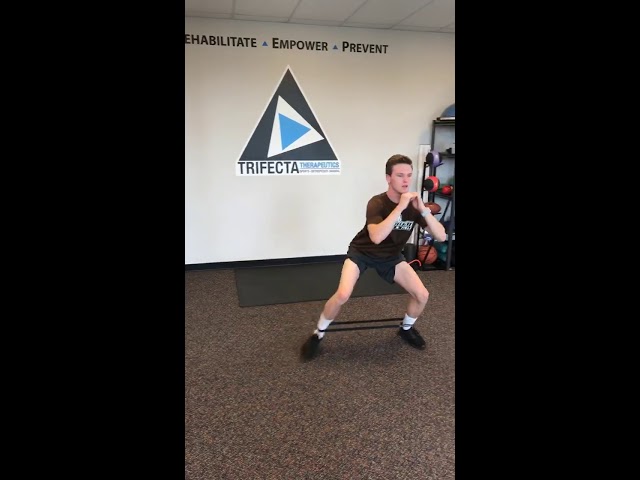
The banded lateral walk steps sideways against resistance band tension, targeting your gluteus medius through dynamic hip abduction while maintaining a partial squat position. This functional movement activates your hip stabilizers before lower body training, improving squat mechanics and reducing knee valgus.
Coaching Note
Place the band above your knees and maintain a quarter squat throughout. Step sideways, leading with one foot and following with the other while keeping tension on the band. Do not let your feet come completely together or the band will go slack.
Banded Lateral Walk — targeted muscles
Why This Exercise Works
Banded lateral walks directly target the gluteus medius, the muscle responsible for hip abduction and pelvic stability. Activating this muscle before squats improves knee tracking and prevents valgus collapse. The band provides resistance throughout the stepping motion.
Also targets: hip abductors, Quadriceps
Want Ely to consider Banded Lateral Walk for your plan?
Share your training details. Ely reviews the full week before anything is delivered.
How do you perform the Banded Lateral Walk?
- 1
Place a resistance band around your thighs above your knees.
- 2
Stand with feet hip-width apart in a quarter squat.
- 3
Take a step to the side, leading with one foot.
- 4
Follow with the other foot, maintaining tension.
- 5
Continue stepping sideways for the prescribed distance.
- 6
Repeat in the opposite direction.
What are the best tips for the Banded Lateral Walk?
Stay low throughout the movement.
Keep tension on the band at all times.
Point toes forward, not outward.
When to Use the Banded Lateral Walk
Program banded lateral walks as warm-up before any lower body training, especially squats and lunges. Use them for 15-20 steps each direction. They pair well with glute bridges and other activation exercises.
What are common Banded Lateral Walk mistakes to avoid?
Standing too upright.
Letting feet come too close together.
Dragging feet instead of stepping.
Banded Lateral Walk — who it's best for
Everyone before squatting or lower body work. Athletes needing hip stability for cutting and lateral movement. Those with knee valgus (knees caving) during squats.
Programming examples for Banded Lateral Walk
The sets, reps, and rest times below are examples. Adjust them for your current ability, the exercise, and your total training. These ranges are not exclusive to one goal.
Example: 3 sets of 15-20 steps each direction. Rest 45s.
Muscle Growth
12-15 steps each direction
Example rest: 90s-2min; extend as needed
Strength
8-10 steps each direction
Example rest: 2-3min; extend as needed
Endurance
20+ steps each direction
Example rest: 60s; extend as needed
Where to Use in Your Workout
Use in warm-ups before any lower body exercise. The activation carries into your working sets for improved form and stability.
Sample Workout Blocks
Week 1: 2x15 steps/direction | Week 2: 2x20 steps/direction | Week 3: 3x15 steps/direction | Week 4: 2x15 steps/direction
Want help choosing exercises, sets, and reps for your schedule? Ely reviews purchased plans before delivery.
Get Your Custom PlanWhere Banded Lateral Walk fits in your workout
This is one example of how Banded Lateral Walk could sit inside a complete workout. Your plan may use different movements after Ely checks your assessment.
Sample workout
- Squat or Leg Press4 × 8
- Romanian Deadlift3 × 10
- Banded Lateral Walk3 × 12
- Calf Raise3 × 15
Use this exercise in Gym Mode
MySetPlan guides you set by set, times your rest, records your work, and tells you what to do next from the plan Ely approved.
Start My $19 WeekWhat are good alternatives to the Banded Lateral Walk?
Other Variations
- Monster Walk
- Banded Squat Walk
- X-Band Walk
Want a plan you do not have to piece together?
Share your goal, schedule, equipment, and experience. Ely checks the complete exercise selection before he approves your week.
Start My $19 Starter Week$19 once · No automatic renewal · Delivered in 1–3 business days
Related Content
Safety Notes
- Choose appropriate band resistance.
- Keep knees tracking over toes.
- General fitness education only. This is not medical advice or a rehabilitation protocol. Stop if you feel pain, and follow a licensed healthcare professional for an injury, medical condition, or return after surgery.