General exercise guide
Band Anti-Rotation Press
Save
Primary
Core
Secondary
Shoulders
Equipment
Resistance Band
Difficulty
Beginner
Type
Isometric
See how Band Anti-Rotation Press could fit a workout
The example below shows one possible placement. Your purchased plan is built from your assessment, and Ely checks every exercise before approving it.
One-time purchase · Checked by Ely · Delivered in 1–3 business days
This page is not medical advice or a rehabilitation protocol. Ely's personal review applies to purchased workout plans and does not replace an in-person assessment by a licensed healthcare professional.
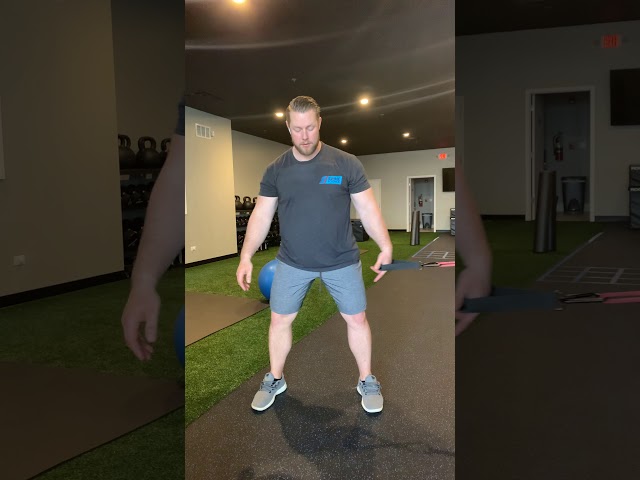
The band anti-rotation press is a portable version of the Pallof press using a resistance band anchored at chest height. You press the band away from your chest while resisting its rotational pull. This makes anti-rotation training accessible anywhere you can anchor a band.
When to use it
Use for home core training for optimal results.
Who it's for
All fitness levels looking to build strength and muscle definition.
Coaching Note
Secure a band at chest height around a sturdy anchor. Stand perpendicular to the anchor, holding the band at your chest. Press straight out, pause briefly, then return with control. Keep your hips and shoulders square throughout.
Band Anti-Rotation Press — targeted muscles
Also targets: Shoulders
Want Ely to consider Band Anti-Rotation Press for your plan?
Share your training details. Ely reviews the full week before anything is delivered.
How do you perform the Band Anti-Rotation Press?
- 1
Anchor band at chest height.
- 2
Stand perpendicular to anchor.
- 3
Hold band handle at chest.
- 4
Press band straight out.
- 5
Resist the rotational pull.
- 6
Return to chest and repeat.
What are the best tips for the Band Anti-Rotation Press?
Portable version of Pallof press.
Great for home training.
Don't let body rotate.
Control the movement.
When to Use the Band Anti-Rotation Press
Use the band anti-rotation press for home workouts, travel training, or when cables are unavailable. The variable resistance of bands provides unique tension curves. Include it in circuit training or as an accessible core option.
Common Band Anti-Rotation Press mistakes
Allowing rotation for optimal results.
Isometric holds like the Band Anti-Rotation Press build strength at specific joint angles. This mistake changes the angle and reduces how hard your Obliques has to work. Lock into position and hold it.
Using band that's too heavy.
Loading more weight than you can control on the Band Anti-Rotation Press often creates compensations that shift work away from your Obliques. Reduce the load until each rep follows the intended path.
Not pressing straight.
Isometric holds like the Band Anti-Rotation Press build strength at specific joint angles. This mistake changes the angle and reduces how hard your Obliques has to work. Lock into position and hold it.
Band Anti-Rotation Press — who it's best for
All fitness levels looking to build strength and muscle definition.
Programming examples for Band Anti-Rotation Press
These ranges illustrate ways to organize training. They are not an individual prescription. Adjust them for the exercise, your experience, and the rest of your program.
Strength8-10 reps per side
Heavier loads can be useful for developing maximum strength. The range shown is an example, and the load must match your current technique and capacity.
Muscle Growth10-15 reps per side
Muscle growth can occur across different loads and repetition ranges. This example is not a uniquely effective zone; your overall program and effort also matter.
Endurance15-20 reps per side
This is an example of a longer set. A repetition target alone does not establish joint safety or whether the exercise is appropriate for you.
Example: 3 sets of 10-12 reps per side. Rest 45s.
Background for resistance exercises: the 2026 ACSM position stand covers healthy adults, and a load-comparison review found similar muscle growth across loads in studies using sets taken to muscular failure. These findings do not validate every exercise-specific range shown here or require training to failure.
Where Band Anti-Rotation Press fits in your workout
This is one example of how Band Anti-Rotation Press could sit inside a complete workout. Your plan may use different movements after Ely checks your assessment.
Sample workout
- Main Movement4 × 8
- Secondary Movement3 × 10
- Band Anti-Rotation Press3 × 12
- Accessory Movement3 × 15
Use this exercise in Gym Mode
MySetPlan guides you set by set, times your rest, records your work, and tells you what to do next from the plan Ely approved.
Start My $19 WeekWhat are good alternatives to the Band Anti-Rotation Press?
Other Variations
- Band Pallof Hold
- Split-Stance Band Press
Want a plan you do not have to piece together?
Share your goal, schedule, equipment, and experience. Ely checks the complete exercise selection before he approves your week.
Start My $19 Starter Week$19 once · No automatic renewal · Delivered in 1–3 business days
Related Content
Safety Notes
- Secure band properly.
- Don't rotate.